French TEF Canada: Mastering the Exam for CRS Points
Dr. Shruti Mehtaa
Director & Ph.D. Expert
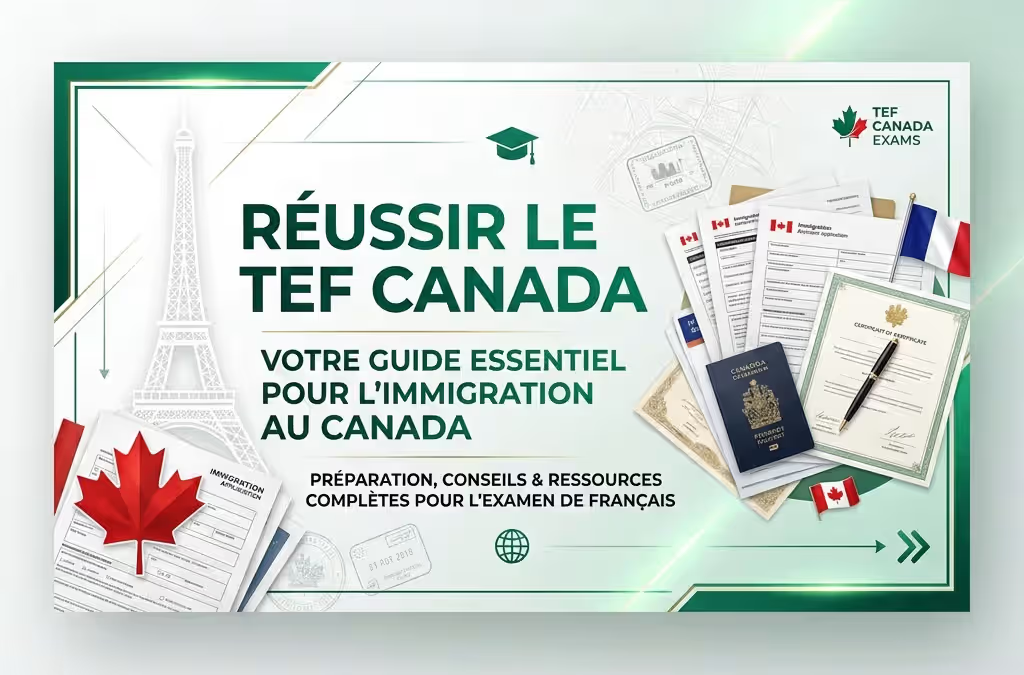
Table of Contents
French TEF Canada: Mastering the Exam for CRS Points refers to the comprehensive methodology, structural criteria, and strategic preparations necessary in 2026 for students and professionals looking to optimize their exam scores, study abroad applications, or global migration outcomes in line with updated international standards.
French TEF Canada: The Ultimate CRS Booster
If you’re looking for the fastest way to increase your Express Entry points in 2026, the French language is the answer. With Canada’s strong push for Francophone immigration, achieving even a basic proficiency in French (NCLC 7) can grant you up to 50 additional CRS points, regardless of your original background.
Targeting the 62+ Point French Bonus?
Join our specialized French TEF/TCF batch starting every Monday.
Choosing Your Exam: TEF vs TCF
While both exams are accepted, there are critical differences in how they are administered.
Not sure which exam to pick?
Our experts in Nagpur, Hisar, and Delhi can help you decide.
 Consult an Expert
TEF Canada (Test d’Évaluation de Français)
The TEF is known for its “adaptive” structure. It’s often favored by students who are good at multiple-choice questions but might struggle with open-ended conversation. The TEF Speaking section is highly structured, revolving around roleplays—one where you ask questions about an advertisement (Section A) and another where you persuade a friend (Section B).
TCF Canada (Test de Connaissance du Français)
The TCF is a more “linear” exam. Many students find the Speaking and Writing sections of the TCF slightly more flexible, as they feel more like a natural conversation and formal letter writing, respectively. At our center, we recommend TEF for those who prefer “template-driven” learning and TCF for more “natural” speakers.
Mastering Writing Section C: The Strategy
Writing is often where students struggle to reach the required NCLC 7 (Level B2).
Focus on Connectors
The use of logical connectors like néanmoins (nevertheless), par conséquent (consequently), and d’autant plus que (even more so because) is essential. These show the examiner that you can link complex ideas together logically.
The Section B Persuasion Method
In TEF Writing Section B, you must write a formal letter to a newspaper editor or authority. The goal is not just to state your opinion but to convince the reader. Use rhetorical questions and emotional appeals to earn the highest marks in the coherence and cohesion category.
Native-like Fluency Tips: The NCLC 7 Blueprint
How do you sound like a B2-level speaker in just a few months?
Immerse Yourself Daily
Don’t just study from books. Listen to French podcasts like “InnerFrench” or watch “Call My Agent” (Dix pour cent) with French subtitles. This helps your brain absorb the natural rhythm and “liaisons” of the language.
Phonetics Matter
Proper French pronunciation isn’t just about sounding “fancy”—it’s about accuracy. Pay close attention to nasal sounds (-un, -in, -on) and the difference between the ‘u’ and ‘ou’ sounds. If an examiner can’t understand your pronunciation, your fluency score will drop, no matter how good your grammar is.
Is TEF Canada Right for You?
If you have a CRS score between 400 and 450, and you’re struggling to bridge the gap to 500+, French is your only viable option outside of a PNP. It may seem daunting, but with our specialized “Ph.D. Coaching Methodology,” we have helped students go from Zero to B2 in less than 6 months.
Final Success Checklist
- Mock Tests: Take at least 3 full-length mocks before the real exam.
- Vocabulary Pools: Build a vocabulary “pool” for common topics like Environment, Work, Education, and New Technologies.
- Daily Writing: Write at least 150 words of French every single day, and have it corrected by an expert.
Unlock your Canadian dream with the power of French. Enroll in our specialized TEF/TCF batches today!
📊 Key Factors & Standards Overview (2026)
| Critical Parameter | standard Requirement | Recommended Target | Strategic Value / Advantage |
|---|---|---|---|
| Academic Benchmark | Minimum 60% - 70% GPA | First-Class Division (75%+) | Unlocks elite university admissions |
| Language Score | IELTS 6.0 / PTE 50 minimum | IELTS 7.0+ / PTE 65+ | Eliminates study visa hurdles |
| Financial Proof | Blocked Funds / SDS GIC | Full 1st Year Tuition + Living | Shows absolute self-sufficiency |
| Immigration Alignment | Occupation demand checking | STEM & Critical Sectors | Accelerates permanent residency paths |
Crucial Strategic Insights for 2026
To achieve success in this pathway, candidates must adopt a forward-looking approach. The 2026 study abroad and migration landscapes are highly competitive, requiring meticulous documentation. Gone are the days when a basic application would guarantee admission or visa approvals.
Your study plan must align directly with your professional aspirations and the local labor shortages of your destination country. Seeking expert counseling, participating in target mock interviews, and starting your documentation 6 months prior to the intakes are the absolute keys to success.
Still Have Questions About This Topic?
Get clarity from Dr. Shruti Mehtaa's team — drop your details and we'll connect you on WhatsApp.
Thank You!
Redirecting you to WhatsApp to connect with our team...
Global Study Abroad Handbook
Our comprehensive guide to university admissions, SOP writing, and visa processes for top global destinations.
DR. SHRUTI'S
THE 8.5 BLUEPRINT
Frequently Asked Questions
What are the target requirements for French TEF Canada: Mastering the Exam for CRS Points?
How long is my preparation time for this pathway?
Can I apply for migration directly through this route?
More Related Insights
Foreign Languages
German Language Coaching in Hisar: Complete Guide A1 to C2 for Study & Work in 2026
Jun 19, 2026

Immigration
Express Entry Overhaul 2026: Proposed Reforms to Canada's Immigration System Explained
Jun 27, 2026

Immigration
Australia PR in 2026: 189 vs 190 vs 491 - Which Visa Path Is Best for You?
Apr 23, 2026
About the Author
Dr. Shruti Mehtaa (Ph.D.) is a renowned global expert in language proficiency and immigration. With over 15 years of excellence, she has mentored 10,000+ students to achieve their dreams of global education and migration.