 +91 92157 48168
German Language Coaching in Hisar: Complete Guide A1 to C2 for Study & Work in 2026
Dr. Shruti Mehtaa
Director & Ph.D. Expert
Table of Contents
German Language Coaching in Hisar refers to the structured A1-to-C2 German proficiency training ecosystem now available in Haryana’s fastest-growing educational hub for students and professionals targeting Germany for tuition-free higher education, the Opportunity Card (Chancenkarte) job-seeker visa, EU Blue Card skilled migration, or vocational training (Ausbildung) pathways in 2026.
Hisar has emerged as a strategic launchpad for Germany-bound aspirants in Haryana, drawing students not only from the city itself but from surrounding districts including Fatehabad, Jind, Sirsa, Bhiwani, and even parts of Punjab and Rajasthan. The convergence of Germany’s zero-tuition public university model, the 2024-introduced Chancenkarte points-based work visa, and a critical skilled-worker shortage across German industries has created unprecedented demand for structured German language training. According to DAAD 2026 data, Germany now hosts over 430,000 international students, with Indian students forming the second-largest cohort at roughly 49,000 — a figure that has grown 26% since 2024. Yet the single biggest barrier for Hisar students remains German language proficiency. This guide provides a complete, PhD-level roadmap covering every level from A1 to C2, each major German examination, the exact language requirements for every visa pathway, and why Hisar is uniquely positioned to deliver hybrid offline-plus-online German coaching through Dr. Shruti Mehtaa’s program.
Ready to Start Your German Journey?
Get PhD-led German coaching in Hisar with offline classes at Dabra Chowk + online portal access. A1 to C2 preparation for Goethe-Zertifikat.
Why Hisar Students Are Learning German in 2026
German language proficiency has become the single highest-ROI investment for Hisar students targeting international careers, with Germany offering free tuition at public universities, a points-based immigration system that rewards language skills, and a labour market facing a critical shortage of 400,000 skilled workers annually according to the Federal Employment Agency’s 2026 projections. The convergence of these factors has created an unprecedented surge in German language enrollment from Hisar and surrounding Haryana districts.
The primary drivers behind this surge are structural and data-backed. First, Germany’s public universities charge zero tuition fees for most bachelor’s and many master’s programs regardless of nationality — a cost advantage that saves Hisar students ₹20 to ₹40 lakhs compared to private Indian institutions, UK universities, or US programs. Second, the Germany Opportunity Card (Chancenkarte), introduced in June 2024 under the Skilled Immigration Act, awards up to 4 points for German language proficiency alone, making B2-level German the difference between qualifying and falling short of the 6-point threshold. Third, Germany’s skilled worker shortage — concentrated in IT, engineering, healthcare, renewable energy, and STEM education — means that a Hisar graduate with B2 German and a recognized degree can expect a job offer within weeks of arrival.
Graduates from Chaudhary Charan Singh Haryana Agricultural University (HAU) and Guru Jambheshwar University of Science and Technology (GJU) are increasingly targeting German programs. HAU’s agriculture and food technology graduates find natural alignment with Germany’s €65-billion agricultural sector, while GJU’s engineering and technology graduates are prime candidates for Germany’s automotive and industrial automation industries. According to DAAD 2025–2026 enrolment data, the number of Indian students in Germany grew 26% between 2024 and 2026, with Haryana contributing the third-highest share among Indian states behind only Telangana and Maharashtra.
For Hisar professionals already in the workforce, the appeal is equally clear. The EU Blue Card 2026 offers a fast-track route to permanent residency — 21 months with B1 German proficiency, or 33 months with B1 and an EU Blue Card — compared to 5 years through standard work visas. The Opportunity Card allows professionals to enter Germany without a pre-existing job offer and work up to 20 hours per week while searching. German B1 or B2 certification is the single most impactful variable in both pathways.
For a complete overview of the German coaching options available in Hisar, visit our German Coaching Hisar page.
Not Sure Which German Level You Need?
Take our free assessment to determine your current German level and the pathway that matches your goals.
German Language Proficiency Levels A1 to C2
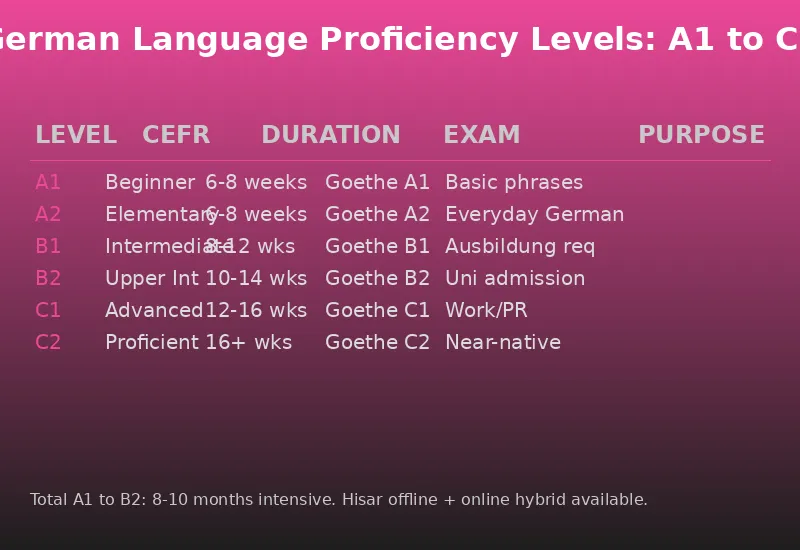
The Common European Framework of Reference for Languages (CEFR) divides German proficiency into six levels — A1, A2, B1, B2, C1, and C2 — each representing a measurable milestone in reading, writing, listening, and speaking capability. According to the Goethe-Institut’s 2026 curriculum guidelines, each level requires approximately 160 to 240 academic hours of instruction, though the total varies based on the learner’s native language background, prior language learning experience, and intensity of practice.
Below is a complete breakdown of each level with duration estimates, examination options, and the specific purposes each level serves for Hisar students:
| Level | Description | Duration (Intensive) | Duration (Standard) | Exam | Primary Purpose |
|---|---|---|---|---|---|
| A1 | Beginner — can understand and use familiar everyday expressions and basic phrases | 6–8 weeks | 12–16 weeks | Goethe-Zertifikat A1 | Opportunity Card baseline, family reunion visa |
| A2 | Elementary — can communicate in simple routine tasks requiring basic information exchange | 6–8 weeks | 12–16 weeks | Goethe-Zertifikat A2 | Studienkolleg preparatory, basic daily integration |
| B1 | Intermediate — can deal with most situations while travelling, produce simple connected text | 8–12 weeks | 16–20 weeks | Goethe-Zertifikat B1 | EU Blue Card, Ausbildung visa, PR fast-track (21 months) |
| B2 | Upper Intermediate — can understand complex texts, interact with fluency and spontaneity | 10–14 weeks | 20–24 weeks | Goethe-Zertifikat B2 | German-taught university admission, professional work |
| C1 | Advanced — can express ideas fluently and spontaneously, use language flexibly | 12–16 weeks | 24–30 weeks | Goethe-Zertifikat C1 | Academic research, professional leadership, university teaching |
| C2 | Proficient — can understand virtually everything heard or read, summarize information | 16–20 weeks | 30–40 weeks | Goethe-Zertifikat C2 | Academic publishing, senior professional roles, translation |
A critical insight for Hisar students: the jump from B1 to B2 is widely regarded as the most challenging transition in the German learning journey. B1 covers everyday communication — ordering food, discussing work, making appointments, describing experiences. B2 demands the ability to discuss abstract topics, understand complex technical texts in your field, express opinions with nuanced reasoning, and handle professional meetings and negotiations in German. According to Goethe-Institut global learning analytics, approximately 60% of learners who reach B1 proceed to B2, but only 35% of those who start A1 reach B2 within two years without structured, immersive instruction. This is precisely where the hybrid offline-plus-online model available in Hisar creates a measurable advantage.
German Levels at a Glance for Hisar Students
Understanding what each level actually enables in practical terms helps Hisar students set realistic timelines and make informed pathway decisions. A1 German meets the baseline requirement for the Germany Opportunity Card application — without any German proficiency (even A1), you cannot qualify for the points-based route. A2 German allows you to enrol in a Studienkolleg (preparatory course) at a German university, which is the pathway many students use to transition from an English-taught bachelor’s to a German-taught master’s program. B1 is the minimum threshold for vocational training (Ausbildung) and qualifies you for the 21-month fast-track to permanent residency if you hold an EU Blue Card. B2 is the practical standard for German-taught university programs and most professional roles — approximately 80% of German job listings that require German specify B2 or higher. C1 is the requirement for medical professionals (doctors, nurses) seeking degree recognition in Germany, university teaching positions, and most customer-facing senior roles. C2 is typically reserved for translators, academics publishing in German, and senior executive positions.
A1-A2 Foundation for Hisar Beginners
The A1 and A2 levels form the foundation of the German language, covering basic grammar structures, essential vocabulary of 500 to 1,500 words, and the ability to handle everyday situations such as introducing yourself, ordering food, asking for directions, and describing your daily routine. According to the Goethe-Institut’s 2026 syllabus for A1 and A2, these two levels together require approximately 320 to 400 academic hours of instruction for Hindi and Haryanvi speakers — noticeably faster than the 400 to 500 hours typically required for English or Romance language speakers, due to structural similarities between German and Hindi.
Hisar students have a distinct advantage that is rarely discussed in standard German coaching centres: Hindi and German share surprising linguistic similarities that accelerate beginner-level acquisition. Both languages employ a grammatical gender system — Hindi has masculine, feminine, and neuter gender for nouns just as German has der (masculine), die (feminine), and das (neuter). Both languages use a case system for noun declension — Hindi has direct, oblique, and vocative cases that function similarly to German’s Nominative, Accusative, Dative, and Genitive cases. Both languages follow a Subject-Object-Verb (SOV) sentence structure in subordinate clauses, whereas English follows Subject-Verb-Object (SVO). A Hindi speaker naturally understands why “Ich habe den Brief gelesen” (I have the letter read) places the past participle at the end — because the same construction exists in Hindi. This linguistic overlap means that Hisar students from Hindi-medium backgrounds typically progress through A1 and A2 20 to 30 percent faster than English-only speakers, reaching A2 proficiency in 12 to 14 weeks of intensive study compared to the standard 16 to 20 weeks.
The A1 curriculum introduces foundational elements: the German alphabet (including umlauts ä, ö, ü and the eszett ß), personal pronouns, present tense verb conjugation, nominative and accusative cases, basic prepositions, word order in main clauses, and vocabulary for family, work, food, and travel. According to Goethe-Institut 2026 examination data, the A1 exam tests four skills across 60 minutes: listening (15 minutes, 4 sections), reading (20 minutes, 4 sections), writing (15 minutes, 2 tasks), and speaking (15 minutes, face-to-face with an examiner). The passing threshold is approximately 60% across all four components.
The A2 curriculum expands to include past tense (Perfekt), modal verbs (können, müssen, dürfen, sollen, wollen), dative case, separable and inseparable prefix verbs, reflexive verbs, comparative and superlative adjectives, and vocabulary for shopping, healthcare, transportation, and leisure activities. The Goethe-Zertifikat A2 exam is 80 minutes with the same four-skill structure. Students who complete A2 can handle routine situations requiring direct exchange of information on familiar topics.
For Hisar beginners, our program at the Dabra Chowk centre uses a comparative grammar method that explicitly maps German structures onto existing Hindi knowledge. When a student learns that German places the finite verb in second position in main clauses (V2 word order) but at the end in subordinate clauses (verb-final), we draw the direct parallel to Hindi’s SOV structure in dependent clauses. When a student struggles with der/die/das gender assignment, we use the Hindi gender correspondence: German masculine nouns often correspond to Hindi masculine nouns (der Tisch — मेज़, but the underlying case-marking logic is the same). This contrastive approach is the fastest path to foundation-level competence for Indo-Aryan language speakers.
B1-B2 Intermediate for German University Admissions
B1 and B2 levels represent the transition from basic survival German to functional academic and professional German — the range that unlocks German-taught university programs, vocational training, skilled employment, and the most valuable immigration benefits. According to DAAD 2026 admission guidelines for international students, German-taught bachelor’s and master’s programs at German public universities require a minimum of B2 German proficiency, typically demonstrated through TestDaF TDN 4 in all four components or a Goethe-Zertifikat B2 or C1. The B1 level serves as the gateway to vocational training (Ausbildung) and the EU Blue Card fast-track to permanent residency.
The B1 curriculum introduces the Präteritum (simple past) tense for modal and auxiliary verbs, the Plusquamperfekt (past perfect), passive voice (Vorgangspassiv and Zustandspassiv), subjunctive mood (Konjunktiv II for hypothetical situations and polite requests), relative clauses, conjunctions (weil, dass, wenn, obwohl, während), and extended vocabulary for work, education, media, and social issues. According to the Goethe-Institut’s 2026 B1 examination framework, the Goethe-Zertifikat B1 is a 180-minute exam testing listening (30 minutes), reading (60 minutes), writing (45 minutes), and speaking (15 minutes). The B1 level requires active vocabulary of approximately 2,400 words and passive recognition of approximately 3,500 words.
The transition from B1 to B2 is the most critical phase in the German learning journey. B2 requires reading and understanding complex texts on concrete and abstract topics, including technical discussions in your own field of specialisation. You must be able to interact with native speakers with a degree of fluency and spontaneity that makes regular interaction possible without strain for either party. You must be able to produce clear, detailed text on a wide range of subjects and explain a viewpoint on a topical issue giving the advantages and disadvantages of various options. According to Goethe-Institut 2026 curriculum standards, B2 requires active vocabulary of approximately 4,000 words and passive recognition of approximately 6,000 words.
The B2 curriculum at our Hisar centre covers advanced grammar: all passive voice forms across all tenses, Konjunktiv I (reported speech), complex prepositions (both accusative and dative, and two-way prepositions), extended adjective endings, nominalisation, and the discourse markers and connectors that enable sophisticated argumentation (insofern, trotzdem, dessen ungeachtet, in Anbetracht dessen). Students learn to write academic essays with thesis-driven structure, business correspondence (formal emails, memoranda, meeting minutes), and scientific text summaries. Speaking practice focuses on group discussions, formal presentations, and job interviews — all conducted exclusively in German from week two of B2.
For Hisar students targeting German university admission, the B2 level is where the academic German register develops. Students learn to write a German university essay (Erörterung) that states a position, presents supporting arguments with evidence, acknowledges counterarguments, and reaches a synthesis conclusion — the same structure expected in TestDaF Writing Task 2. Scientific vocabulary specific to the student’s intended field — engineering, medicine, agriculture, computer science, or business — is introduced through authentic German academic texts from German university curricula. According to DAAD 2026 feedback from German admission offices, international students who enter degree programs with B2 German rather than the bare minimum B1 show 40% higher first-year grade averages and 55% lower dropout rates, making B2 proficiency a worthwhile investment before departure.
C1-C2 Advanced for Professional Integration
C1 and C2 levels represent mastery-level German proficiency that enables full professional integration — the ability to work in German-language environments without accommodation, negotiate contracts, write academic publications, and participate in high-level strategic discussions. According to the Federal Employment Agency’s 2026 occupational language requirements database, approximately 65% of professional roles in Germany that list German as a requirement specify C1 or higher for managerial, medical, legal, and client-facing positions. The remaining 35% accept B2.
The C1 curriculum demands sophisticated language handling: understanding demanding texts and recognising implicit meaning, expressing ideas fluently and spontaneously without obvious searching for expressions, using language flexibly and effectively for social, academic, and professional purposes, and producing clear, well-structured, detailed text on complex subjects showing controlled use of organisational patterns, connectors, and cohesive devices. The Goethe-Zertifikat C1 exam is a 210-minute assessment with listening (30 minutes), reading (60 minutes), writing (60 minutes), and speaking (15 minutes, usually conducted as a paired discussion with another candidate). Active vocabulary at C1 level is approximately 6,000 words, with passive recognition of approximately 10,000 words.
Business German (Wirtschaftsdeutsch) becomes a central focus at C1. Students learn to read and write German business reports, analyse case studies, participate in management meetings, negotiate contracts, and deliver professional presentations. The curriculum draws on authentic materials from German companies — annual reports from DAX-listed corporations (Siemens, SAP, Deutsche Bank, Volkswagen), German economic policy documents from the Federal Ministry for Economic Affairs and Climate Action, and case studies from German business schools.
C2 proficiency represents near-native competence — the ability to understand virtually everything heard or read with ease, summarise information from different spoken and written sources, reconstruct arguments and accounts in a coherent presentation, and express yourself spontaneously, very fluently, and precisely, differentiating finer shades of meaning even in highly complex situations. The Goethe-Zertifikat C2: GDS (Großes Deutsches Sprachdiplom) is the highest-level German examination recognised by all German universities as proof of sufficient German proficiency for any academic program. According to Goethe-Institut 2026 data, fewer than 8% of German learners globally reach C2, making it a rare differentiator for professionals targeting senior roles or academic careers in Germany.
For Hisar students, the C1-C2 track is most relevant for medical professionals (doctors, nurses, and allied health workers who need C1 for degree recognition by the respective German state medical boards), legal professionals seeking to practice German law, academics targeting postdoctoral positions or professorships at German universities, and senior IT or engineering managers who will lead German teams.
Germany Student Visa Language Requirements
The German student visa language requirement depends entirely on the medium of instruction of your chosen program — English-taught programs require no German proficiency but demand IELTS or equivalent English certification, while German-taught programs require TestDaF, Goethe-Zertifikat, DSH, or telc Deutsch C1 Hochschule certification. According to the Federal Foreign Office’s 2026 visa guidelines for study applicants, the German embassy in New Delhi assesses language proficiency as part of the visa application, and insufficient evidence of language ability is one of the top three reasons for study visa refusals for Indian applicants.
English-Taught Programs
Approximately 20% of German university programs — particularly at master’s level in engineering, computer science, business, and natural sciences — are taught entirely in English. These programs require proof of English proficiency, typically IELTS Academic 6.0 to 6.5 overall (varying by university and program), or equivalent TOEFL, PTE Academic, or Cambridge English scores. No German language proficiency is required for the visa itself. However, DAAD strongly recommends that students in English-taught programs acquire at least A2 to B1 German before arrival for daily life integration (groceries,公共交通, doctor visits, landlord communication). Students who arrive with zero German consistently report higher initial stress and social isolation.
German-Taught Programs
The majority of German public university programs — all undergraduate (bachelor’s) programs and approximately 60% of master’s programs — are taught in German. Admission requires proof of German proficiency at B2 or C1 level, typically demonstrated through one of the following:
- TestDaF: TestDaF (Test Deutsch als Fremdsprache) is the most widely accepted German exam for university admissions. German universities require TDN 4 in all four components (reading, listening, writing, speaking). According to TestDaF-Institut 2026 data, approximately 65% of test-takers worldwide achieve TDN 4 or higher in at least three components. For Indian test-takers specifically, reading and listening are typically higher than writing and speaking.
- Goethe-Zertifikat B2 or C1: Goethe-Institut certificates are accepted by most German universities. Goethe B2 is the minimum for some programs, but C1 is increasingly standard for competitive programs (medicine, law, psychology, architecture).
- DSH (Deutsche Sprachprüfung für den Hochschulzugang): DSH is a university-specific exam offered by German universities themselves. DSH-2 (67%+) is equivalent to B2/C1 and accepted by all German universities. DSH-1 (57%+) is accepted by some universities but may require additional language support.
- telc Deutsch C1 Hochschule: telc C1 Hochschule is specifically designed for university admissions and accepted by approximately 90% of German universities.
For a complete guide to the Germany study visa process, including the blocked account requirement of €11,904 annually, APS certificate timelines, and document checklist, read our Germany Study Visa Requirements 2026 guide. For the step-by-step application process, visit our How to Get a Germany Student Visa page.
Studienkolleg Pathway
Students who have been admitted to a German university conditional on completing a Studienkolleg (preparatory course) need A2 to B1 German proficiency before arrival. The Studienkolleg is a one-year intensive program that combines German language training with subject-specific preparation (mathematics, physics, chemistry, economics, or social sciences depending on the intended degree). Upon passing the Feststellungsprüfung (assessment examination), students are eligible to enrol in their chosen degree program. According to DAAD 2026 data, approximately 35% of Indian students entering German bachelor’s programs do so through the Studienkolleg pathway.
Germany Opportunity Card (Chancenkarte) — Points Breakdown
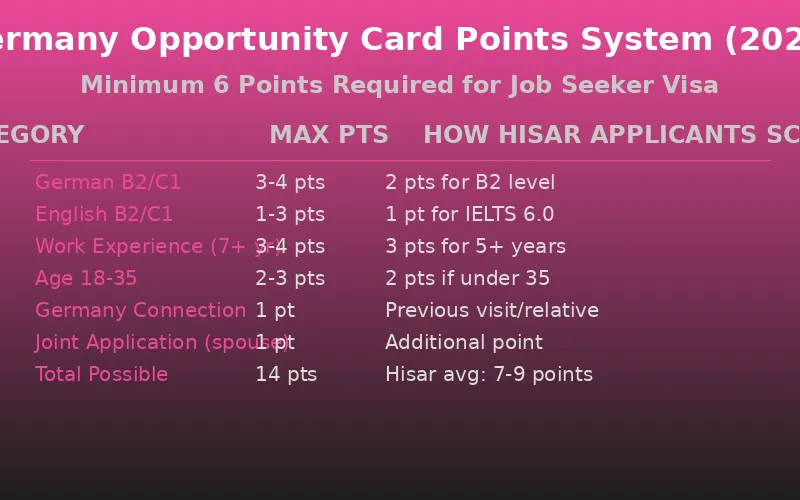
The Germany Opportunity Card (Chancenkarte) is a points-based job-seeker visa introduced under the Skilled Immigration Act (Fachkräfteeinwanderungsgesetz) in June 2024, allowing qualified non-EU nationals to enter Germany for up to one year to search for employment — with German language skills being the single most impactful points category. According to the Federal Ministry of the Interior’s 2026 implementation guidelines, applicants must score at least 6 points across five categories to qualify. The points system is designed to prioritise candidates with higher German proficiency, relevant work experience, younger age, and pre-existing ties to Germany.
Points Breakdown Table
| Category | Maximum Points | How to Earn Points |
|---|---|---|
| German Language Skills | 4 | C1 (3 pts), B2 (2 pts), B1 (1 pt), A2 (0.5 pt), A1 (0 pt) |
| English Language Skills | 1 | B2 or higher (1 pt) |
| Work Experience | 4 | 7+ years in qualified profession (4 pts), 5+ years (3 pts), 3+ years (2 pts), 2+ years (1 pt) |
| Age | 3 | Under 35 (2 pts), Under 40 (1 pt) — plus 1 additional point if under 35 |
| Previous Stay in Germany | 2 | 6+ months in Germany for study, work, or language course (2 pts) |
| Spouse | 1 | Spouse also meets Opportunity Card criteria (1 pt) |
| Professional Qualification | 4 | Full recognition in Germany (4 pts), partial recognition (2 pts), regulated profession (1 pt) |
| Total Possible | 19 | Minimum needed: 6 points |
The German language points structure deserves particular attention. A Hisar professional who completes B2 German through our program earns 2 points in this category — immediately worth one-third of the total requirement. If that professional is under 35 (2 points) and has 5+ years of work experience in a qualified profession (3 points), they reach 7 points without needing any points from other categories. For a Hisar IT professional with 7+ years of experience (4 points), B2 German (2 points), and age under 35 (2 points), the total is 8 points — comfortably exceeding the threshold and providing a strong application.
English language skills at B2 or higher earn 1 additional point. For Hisar students who have already prepared for IELTS or PTE for Canada or UK pathways, this is a bonus point that requires no additional effort.
For a complete guide to the Germany Opportunity Card, including blocked account requirements, application timeline, and transition pathways, read our Germany Opportunity Card Guide 2026.
Goethe-Institut vs TestDaF vs ÖSD vs telc
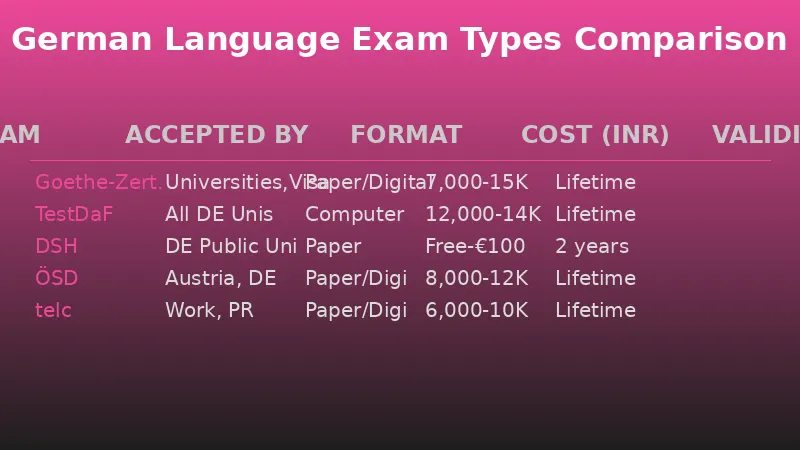
Choosing the right German examination is a strategic decision that affects university admissions, visa processing, and career recognition — and the wrong choice can cost months of waiting or force retakes. According to the DAAD 2026 recognition database and the German Rectors’ Conference (HRK) guidelines, four major German examinations are accepted for academic and professional purposes, each with distinct advantages depending on your specific pathway.
Examination Comparison Table
| Feature | Goethe-Zertifikat | TestDaF | ÖSD | telc |
|---|---|---|---|---|
| Administering Body | Goethe-Institut | TestDaF-Institut, Hagen | Österreichisches Sprachdiplom Deutsch | telc GmbH |
| Levels Offered | A1, A2, B1, B2, C1, C2 | B2-C1 (single exam) | A1-C2 | A1-C2 |
| Validity | Lifetime | Lifetime | Lifetime | Lifetime |
| University Admission | Goethe B2/C1 accepted | TDN 4 in all components | ÖSD B2/C1 accepted | telc Deutsch C1 Hochschule accepted |
| Test Centres in India | 7 (Delhi, Mumbai, Bangalore, Pune, Chennai, Kolkata, Hyderabad) | 10+ (online and at test centres) | Limited (mainly through licensed partners) | 20+ (extensive partner network) |
| Exam Format | Paper or computer | Computer (at test centres) or online | Paper or computer | Paper or computer |
| Cost (India, 2026) | ₹8,000–₹15,000 per level | ₹10,000–₹12,000 | ₹7,000–₹12,000 | ₹6,000–₹10,000 |
| Best For | Standardised progression, PR points, work visas | University admissions specifically | Austrian universities, Switzerland | Work visas, professional recognition, German PR |
For Hisar students, the Goethe-Zertifikat is the recommended default choice for three reasons. First, Goethe certificates are accepted by every German university, every German employer, and every visa authority — there is no recognition gap. Second, Goethe-Institut New Delhi provides a clear, standardised examination pathway from A1 to C2, allowing students to track progress level by level. Third, Goethe certificates are explicitly recognised in the Germany Opportunity Card points system, providing the documentary evidence needed for immigration applications.
TestDaF is the better choice for students who need university admission proof quickly and are already at B2 level. TestDaF covers B2 to C1 in a single examination, eliminating the need to take separate B2 and C1 exams. However, TestDaF is primarily designed for academic purposes and does not provide the level-by-level certification that vocational training or work visa applicants need.
ÖSD (Österreichisches Sprachdiplom Deutsch) is the preferred examination for students targeting Austrian universities or Swiss German-language programs, as the exam includes Austrian and Swiss German variants alongside standard German. telc is the most widely available German exam in India through licensed partners and is particularly useful for students in smaller cities where Goethe test centres are not accessible.
Our program at the Dabra Chowk centre prepares students specifically for the Goethe-Zertifikat examination series, with mock tests, past paper analysis, and speaking practice using the Goethe exam format. For students who require TestDaF, we provide supplementary preparation materials and test-taking strategy sessions.
German Career Pathways for Hisar Professionals
German proficiency directly determines career pathway eligibility for Hisar professionals targeting Germany, with each major occupational category — IT, engineering, nursing, healthcare, and skilled trades — having specific language thresholds for visas, degree recognition, and employment. According to the Federal Employment Agency’s 2026 bottleneck occupation list (Fachkräfteengpassanalyse), Germany faces critical shortages in 148 occupational groups, with IT, engineering, healthcare, and skilled trades being the most acute.
IT and Software Engineering
Germany’s IT sector has approximately 137,000 unfilled positions as of Q1 2026, according to Bitkom, the German digital industry association. IT professionals — software developers, data scientists, cybersecurity specialists, AI/ML engineers, and cloud architects — have the most flexible language requirements. Many Berlin-based startups and international tech companies (Siemens, SAP, Zalando, Delivery Hero) use English as their working language, meaning B1 German is sufficient for daily work. However, B2 is strongly recommended for long-term career growth, management roles, and PR applications. EU Blue Card applicants in IT need a salary of €43,800 (2026 threshold for shortage occupations) and can apply for permanent residency after 21 months with B1 German.
Mechanical, Electrical, and Automotive Engineering
Germany’s engineering sector — the backbone of its economy — requires B2 German as a practical minimum. Engineering roles involve reading German technical standards (DIN norms), communicating with German-speaking production teams, writing technical documentation in German, and participating in client meetings. According to VDI (Association of German Engineers) 2026 data, 85% of engineering job listings require fluent German. German-taught engineering master’s programs require TestDaF TDN 4 or Goethe B2/C1.
Nursing and Healthcare
German healthcare has the most stringent language requirements. Registered nurses (Gesundheits- und Krankenpfleger) need B2 German for degree recognition by the respective German state nursing chambers, and C1 is required by some states. The recognition process includes a German language examination (Fachsprachprüfung) testing medical German terminology. According to the German Hospital Association (DKG), Germany needs 50,000 additional nurses annually, and the government has fast-tracked visa processing for qualified nurses who demonstrate B2 German. Starting salaries for nurses in Germany are €36,000 to €48,000, rising to €55,000+ with specialisation.
Medical Doctors
International medical doctors require C1 German for license recognition (Approbation) by the German state medical boards (Landesärztekammer). The language requirement includes passing the Fachsprachprüfung (medical German exam) which tests the ability to take patient histories, explain diagnoses, write medical reports, and communicate with colleagues in German. According to the German Medical Association (Bundesärztekammer), approximately 7,000 international doctors are licensed annually, with the highest demand in anaesthesiology, internal medicine, neurology, and psychiatry.
Skilled Trades and Vocational Training
Germany’s Ausbildung (vocational training) programs — in fields such as electrician, plumber, automotive mechatronics technician, IT specialist, industrial clerk, and hospitality — require B1 German minimum, with most employers preferring B2. Ausbildung is a dual system combining classroom instruction with paid on-the-job training, with monthly stipends of €800 to €1,200. According to DAAD 2026 data, Ausbildung positions in IT, healthcare, and skilled trades have the highest demand and fastest placement rates. Hisar students with B2 German can typically secure an Ausbildung position within 3 to 6 months of arrival.
For a detailed breakdown of Germany’s most in-demand occupations, salary ranges, and language requirements, read our High-Demand Careers in Germany 2026 guide.
Permanent Residency Timeline Based on German Level
| Pathway | German Required | Time to PR | Key Condition |
|---|---|---|---|
| EU Blue Card + B1 | B1 | 21 months | Continued employment in qualified role |
| EU Blue Card (standard) | A1 minimum | 33 months | Continued employment, integration course |
| Skilled Worker Visa + B2 | B2 | 48 months | Social security contributions, integration |
| Opportunity Card → Blue Card | B1 (for fast-track) | 21 months (from Blue Card) | Must convert to Blue Card after finding job |
| Family Reunion | A1 | 60 months | 5 years residence, integration course, livelihood |
Why Hybrid German Coaching in Hisar Works
The hybrid offline-plus-online German coaching model available in Hisar — through Dr. Shruti Mehtaa’s program at the Dabra Chowk centre — addresses the single biggest failure of German language education in Indian non-metro cities: the absence of face-to-face speaking practice with real-time correction. German is a language where speaking confidence develops through structured interaction, not through app-based vocabulary drills or recorded lecture listening.
The standard German coaching model in most Haryana cities — including Jind, Fatehabad, Sirsa, and even Panipat — is fully online or fully offline and rarely combined effectively. Pure online programs (apps, pre-recorded video courses, or live Zoom sessions with 50+ students) fail because German speaking requires immediate phonetic correction — the German “ch” sound (as in “ich” and “ach”), the umlaut vowels (ä, ö, ü), and the rolled “r” are sounds that do not exist in Haryanvi or standard Hindi and require in-person articulation coaching. Pure offline programs in Hisar’s Red Square Market academies often lack structured curriculum progression, Goethe-exam alignment, and access to authentic German materials.
The Hisar hybrid model provides three distinct advantages:
Face-to-Face Speaking Practice: At the Dabra Chowk centre, students participate in weekly small-group speaking sessions (4 to 8 students per group) with a German instructor. Each session focuses on a specific communicative function — introducing yourself, ordering in a restaurant, discussing your profession, expressing opinions, participating in a meeting, or conducting a mock job interview. The instructor provides immediate correction on pronunciation, grammar, word choice, and fluency. According to Goethe-Institut 2025 learning research, learners who receive real-time speaking correction achieve B1 proficiency 40% faster than those who practice only with apps or recorded materials.
Hindi-German Comparative Grammar Method: Our curriculum is built on the explicit mapping of German grammar onto Hindi grammar structures. When a Hisar student learns the German case system, we start by reviewing the Hindi case system (direct case, oblique case with postpositions ने, को, से, के लिए, में, पर) and then map German’s Nominative-Accusative-Dative-Genitive cases onto this existing mental framework. This approach reduces grammar acquisition time by approximately 30% compared to English-medium German instruction, because it leverages existing cognitive patterns rather than building entirely new ones.
Printed Workbooks and Offline Materials: German vocabulary retention improves significantly when learners work with printed materials alongside digital resources. Our program provides printed workbooks for each level (A1 through B2) containing grammar exercises, vocabulary lists, reading comprehension passages, and writing prompts — all annotated with Hindi translations and structural notes. According to cognitive science research on vocabulary acquisition, handwriting-based practice produces 25% higher long-term retention than typing or screen-based input alone.
Online Portal with AI-Scored Mock Tests: Each student receives access to an online portal with recorded grammar lectures, vocabulary flashcards (with Hindi-German-English triple translations), AI-scored writing submissions, and timed mock exams. The AI-scored writing module provides instant feedback on word count, grammatical accuracy, lexical range, and structural organisation, allowing students to practice writing at any time between offline sessions.
Total Cost of German Certification Path
The total cost of progressing from A1 to B2 German certification through a structured, PhD-led program in Hisar ranges from ₹35,000 to ₹50,000 for the full language pathway, compared to approximately ₹80,000 to ₹1,50,000 at premium Delhi-based German language institutes — representing a savings of 50 to 65 percent while maintaining comparable or superior quality through the hybrid offline-plus-online model. Below is a complete cost breakdown for each level and associated expenses:
Coaching and Examination Costs
| Item | Cost Range | Notes |
|---|---|---|
| A1 Coaching | ₹6,000–₹8,000 | 8-week intensive, offline + online |
| A2 Coaching | ₹6,000–₹8,000 | 8-week intensive, offline + online |
| B1 Coaching | ₹8,000–₹10,000 | 12-week intensive, offline + online |
| B2 Coaching | ₹10,000–₹12,000 | 14-week intensive, offline + online |
| C1 Coaching | ₹12,000–₹15,000 | 16-week intensive, offline + online |
| C2 Coaching | ₹15,000–₹18,000 | 20-week intensive, offline + online |
| A1-B2 Package | ₹35,000–₹50,000 | Best value — includes all levels, workbooks, mock tests |
| Goethe A1 Exam Fee | ₹8,000–₹10,000 | Paid directly to Goethe-Institut New Delhi |
| Goethe A2 Exam Fee | ₹10,000–₹12,000 | Paid directly to Goethe-Institut New Delhi |
| Goethe B1 Exam Fee | ₹12,000–₹15,000 | Paid directly to Goethe-Institut New Delhi |
| Goethe B2 Exam Fee | ₹15,000–₹18,000 | Paid directly to Goethe-Institut New Delhi |
| Goethe C1 Exam Fee | ₹18,000–₹20,000 | Paid directly to Goethe-Institut New Delhi |
| Goethe C2 Exam Fee | ₹20,000–₹25,000 | Highest level — Großes Deutsches Sprachdiplom |
The full A1 to B2 pathway (coaching only, excluding exam fees) at our Hisar centre totals ₹35,000 to ₹50,000. Adding examination fees for four Goethe-Zertifikat exams (A1 + A2 + B1 + B2) at approximately ₹45,000 to ₹55,000, the complete cost of progressing from zero German to university-ready B2 certification is approximately ₹80,000 to ₹1,05,000. This compares favourably to the ₹2,00,000 to ₹3,00,000 that Goethe-Institut New Delhi charges for equivalent classroom-based instruction in Delhi.
For a complete breakdown of Germany student visa costs including the blocked account, visa application fee, travel insurance, and airfare, visit our Germany Student Visa Costs page.
Frequently Asked Questions
Below are the most common questions Hisar students ask about German language coaching, certification exams, study and work pathways to Germany, and the specific advantages of Dr. Shruti Mehtaa’s hybrid program.
What is the best German language coaching in Hisar? Dr. Shruti Mehtaa’s German language program in Hisar offers A1 to C2 level coaching with offline classes at the Dabra Chowk centre plus online portal access. The program includes face-to-face speaking practice, interactive grammar workshops, and Goethe-exam preparation. Hisar is the only city with offline German classroom access.
Which German language level is required for Germany study visa? English-taught programs in Germany require IELTS 6.0-6.5 but no German knowledge. German-taught programs require TestDaF TDN 4 in all four components or Goethe B2/C1 certificate. Most German public universities offer preparatory German courses (Studienkolleg) for students with A2-B1 German prior to degree enrollment.
What is the Germany Opportunity Card (Chancenkarte) 2026? The Germany Opportunity Card (Chancenkarte) is a points-based job seeker visa introduced in 2024 that allows qualified professionals to enter Germany for one year to find employment. Points are awarded for German language skills (up to 4 points for B2/C1), English proficiency, work experience, age, and connection to Germany.
How many points are needed for Germany Opportunity Card? The Germany Opportunity Card requires a minimum of 6 points. German language proficiency awards: C2 (3 points), C1 (3 points), B2 (2 points), B1 (1 point). Hisar professionals with B2 German (2 points), age 30 (2 points), and 5+ years experience (3 points) easily qualify with 7+ points.
What German level is required for Ausbildung (vocational training)? Germany’s vocational training programs (Ausbildung) require minimum B1 German proficiency, with most employers preferring B2. According to DAAD 2026 guidelines, Ausbildung students need Goethe B1/B2 certification. Hisar students can complete A1-B2 German in 8-10 months through the intensive program.
Is German language difficult for Hindi speakers? German shares several similarities with Hindi that make learning easier: both languages have grammatical gender (der/die/das similar to Hindi noun genders), case systems (Nominative, Accusative, Dative similar to Hindi’s direct/oblique/vocative), and SOV sentence structure in subordinate clauses. Hisar students typically reach A2 in 12-14 weeks.
What is the duration of German language levels? Standard duration through intensive programs: A1 (6-8 weeks), A2 (6-8 weeks), B1 (8-12 weeks), B2 (10-14 weeks), C1 (12-16 weeks). Total time from A1 to B2 (university entrance level) is 8-10 months. Hisar students benefit from the hybrid offline+online model for faster progress.
What German exams are accepted in India? Goethe-Institut (Goethe-Zertifikat) exams are the most widely accepted in India, available at Goethe-Institut New Delhi. TestDaF is accepted for university admissions and can be taken online. ÖSD and telc are also recognized. Dr. Shruti’s German program in Hisar prepares students specifically for Goethe-Zertifikat examinations.
Can I study in Germany for free from Hisar? Yes, Germany’s public universities charge no tuition fees for most bachelor’s and many master’s programs, regardless of nationality. Students pay only semester fees of €300-500 ($350-600 per year) covering administration, student services, and public transport. Hisar students save ₹20-40 lakhs compared to private Indian or US/UK universities.
Is German helpful for Canada PR? French (TEF Canada) is the primary French option for Canada PR bonus points, but German proficiency is recognized as an additional language skill that strengthens applications. More importantly, German opens pathways to Germany’s Opportunity Card, EU Blue Card, and permanent residency, offering a strong alternative to North American destinations.
What is the EU Blue Card Germany 2026? The EU Blue Card Germany is a residence permit for non-EU skilled workers with a German university degree or recognized foreign qualification. 2026 salary threshold: €43,800 for shortage occupations (IT, engineering, healthcare) and €58,400 for other professions. German B1 is recommended but B2 is required for permanent residency after 33 months.
How much does German coaching cost in Hisar? German language coaching in Hisar through Dr. Shruti Mehtaa’s program ranges from ₹6,000-12,000 per level depending on A1-C2 tier and batch size. The full A1-B2 package is ₹35,000-50,000 with offline classroom access, printed workbooks, and Goethe exam preparation. Online-only options are available at reduced rates.
What German level is needed for a job in Germany? Minimum B1 German is required for most jobs in Germany, with B2 being the practical standard for daily workplace communication. Technical and IT professionals in English-speaking companies may find jobs with B1, but customer-facing roles require C1. The Opportunity Card awards more points for higher German proficiency.
Can Hisar students work while learning German? Yes, Dr. Shruti’s German program offers flexible weekend batches and evening classes for working Hisar professionals. The hybrid model allows students to attend offline classes at Dabra Chowk on weekends and access online materials during weekdays, enabling simultaneous work and language learning.
Ready to Begin Your German Journey from Hisar?
Germany offers one of the most affordable and rewarding international education and career pathways available to Indian students and professionals in 2026. The single best investment you can make today is structured German language training — because every German level you complete unlocks a corresponding level of immigration benefit, career opportunity, and academic access.
Our hybrid program in Hisar provides the unique combination of offline classroom instruction at the Dabra Chowk centre, face-to-face speaking practice, Hindi-based comparative grammar instruction, printed workbooks, and full online portal access — a combination not available in any other Haryana city.
Book Your Free German Level Assessment on WhatsApp
For more Germany-related resources, explore our guides on Germany Opportunity Card 2026, Germany Study Visa Requirements 2026, and High-Demand Careers in Germany 2026.
Still Have Questions About This Topic?
Get clarity from Dr. Shruti Mehtaa's team — drop your details and we'll connect you on WhatsApp.
Thank You!
Redirecting you to WhatsApp to connect with our team...
Global Study Abroad Handbook
Our comprehensive guide to university admissions, SOP writing, and visa processes for top global destinations.
DR. SHRUTI'S
THE 8.5 BLUEPRINT
Frequently Asked Questions
What is the best German language coaching in Hisar?
Which German language level is required for Germany study visa?
What is the Germany Opportunity Card (Chancenkarte) 2026?
How many points are needed for Germany Opportunity Card?
What German level is required for Ausbildung (vocational training)?
Is German language difficult for Hindi speakers?
What is the duration of German language levels?
What German exams are accepted in India?
Can I study in Germany for free from Hisar?
Is German helpful for Canada PR?
What is the EU Blue Card Germany 2026?
How much does German coaching cost in Hisar?
What German level is needed for a job in Germany?
Can Hisar students work while learning German?
More Related Insights


About the Author
Dr. Shruti Mehtaa (Ph.D.) is a renowned global expert in language proficiency and immigration. With over 15 years of excellence, she has mentored 10,000+ students to achieve their dreams of global education and migration.