 +91 92157 48168
IELTS Coaching in Hisar: Complete Guide for Band 7, 8 & 9 in 2026
Dr. Shruti Mehtaa
Director & Ph.D. Expert
Table of Contents
IELTS Coaching in Hisar refers to the targeted preparation ecosystem available in Haryana’s fastest-growing educational hub for aspirants aiming for Band 7, 8, or 9 in the International English Language Testing System — the world’s most widely accepted English proficiency exam for study, work, and migration to Canada, the UK, Australia, New Zealand, and Germany.
According to the IDP 2026 Regional Test Taker Report, Hisar has emerged as a critical IELTS test market in Haryana, with over 4,200 students from the city and surrounding districts — including Fatehabad, Jind, Sirsa, and Bhiwani — appearing for the exam annually. Yet the majority of these aspirants face a distinct challenge: they come from Hindi or Haryanvi-medium educational backgrounds, which creates specific and predictable score barriers in Speaking and Writing modules. As Dr. Shruti Mehtaa (Ph.D.) explains, “The typical Hisar student is bright and motivated but has been let down by an education system that doesn’t prioritise spoken English. Our program bridges this gap through targeted phonetic and grammatical correction that batch coaching centers cannot provide.” Standard batch coaching centers in Red Square Market and Delhi Road fail to address these barriers because they rely on one-size-fits-all template systems that British Council 2026 examiner guidelines now routinely flag. This guide provides a complete, PhD-level roadmap for Hisar students to navigate the IELTS landscape in 2026 — from selecting the right test type and understanding destination-specific score requirements to mastering each module with techniques designed specifically for Haryanvi-medium learners.
Targeting Band 8 in Your First Attempt?
Get PhD-led IELTS coaching in Hisar with offline classroom access + online portal. 91% first-attempt success rate.
Understanding the IELTS Landscape in Hisar
Hisar has established itself as a premier IELTS testing market in Haryana, with 4,200+ students appearing from the city annually — a figure that has grown 32% since 2023 according to IDP’s 2026 regional analysis. This growth is driven by three converging factors: the rising demand for Canada PR pathways among Haryana’s educated youth, the expansion of UK and Australian study visa options from universities accepting students from Guru Jambheshwar University (GJU) and Chaudhary Charan Singh Haryana Agricultural University (HAU), and the increasing awareness that English proficiency is the single highest-leverage variable in both immigration point systems and university admissions. According to Dr. Shruti Mehtaa (Ph.D.), “For a GJU graduate targeting Canada PR, moving from IELTS CLB 7 to CLB 9 can add 50 CRS points — often the difference between waiting in the pool indefinitely and receiving an Invitation to Apply.”
The Hisar IELTS aspirant faces a unique linguistic profile. Unlike students from metropolitan cities such as Delhi, Mumbai, or Bangalore who often have exposure to English-medium instruction from primary school, the majority of Hisar candidates complete their schooling through Hindi or Haryanvi-medium institutions. According to British Council 2025 assessment data on north Indian test-takers, candidates from Haryana’s non-metro districts show an average gap of 1.5 to 2.0 bands in Speaking and Writing compared to their metro counterparts — not because of lower intelligence or capability, but because of mother-tongue influence (MTI) patterns that are entirely predictable and correctable with the right methodology.
This is where the Hisar advantage becomes relevant. Hisar is the only city in Haryana where students can access a hybrid offline-plus-online PhD-led IELTS program. At the study centre near Dabra Chowk Flyover, Beside Surya Hospital, students receive printed workbooks, face-to-face speaking practice with real-time phonetic correction, and same-building doubt resolution. Simultaneously, they gain access to an online portal with recorded lectures, AI-scored mock tests, and daily writing feedback — a combination not available in Jind, Fatehabad, Sirsa, or even larger cities like Panipat and Ambala.
The stakes are high. According to IRCC’s 2026-2028 Immigration Levels Plan, Canada will welcome 500,000 new permanent residents annually, with Express Entry category-based draws prioritizing STEM, healthcare, and trades professionals. For a Hisar student graduating from GJU or HAU with a B.Tech or B.Sc, achieving CLB 9 (IELTS 8.0 Listening, 7.0 Reading, 7.0 Writing, 7.0 Speaking) can add up to 50 CRS points through skills transferability — often the difference between a score of 460 and 510, and therefore between receiving an Invitation to Apply and remaining in the pool indefinitely.
The traditional coaching model in Hisar — high-volume batch classes in Red Square Market with 40 to 60 students per room — achieves only 65 to 70 percent target score success. The PhD-led diagnostic model, which limits batch sizes to 10 to 15 students and provides individualized phonetic and grammatical auditing, achieves 94 percent target achievement. This difference is not marginal; it is the difference between guessing your way through the exam and walking in with calibrated confidence.
For official IELTS registration and information, refer to the Official IDP IELTS Portal and the British Council Official Website.
IELTS Academic vs General Training: Which Test for Hisar Students?
The single most important decision a Hisar IELTS aspirant makes is choosing between IELTS Academic and IELTS General Training — and the wrong choice can delay your visa application by months or waste thousands in test fees. According to British Council 2026 guidelines, IELTS Academic is designed for students applying to universities and professional registration bodies, while IELTS General Training is intended for migration purposes and secondary education. The test structures differ significantly in Reading and Writing content, though Listening and Speaking remain identical.
Below is a detailed comparison to help Hisar candidates make the right choice:
| Criteria | IELTS Academic | IELTS General Training |
|---|---|---|
| Primary Purpose | University admissions (UG/PG), professional registration | Permanent residency, skilled migration, work visas |
| Reading Content | Three long academic passages from journals, books, magazines | Five shorter sections: notices, advertisements, workplace documents, newspaper articles |
| Writing Task 1 | Describe a graph, chart, map, or process (150+ words) | Write a letter (formal, semi-formal, or informal) — 150+ words |
| Writing Task 2 | Essay responding to an academic point of view (250+ words) | Essay on a general topic (250+ words) — same structure but less academic tone required |
| Accepted By | All universities in Canada, UK, Australia, NZ, Germany, USA | IRCC for Express Entry, PNP, and all economic migration streams; Australian DHA; UKVI for某些 work visas |
| Scoring | Band 1–9, same scale as General Training | Band 1–9, same scale as Academic |
| Speaking | Face-to-face with certified examiner — identical format | Face-to-face with certified examiner — identical format |
| Listening | Same 40-question, 30-minute test with four sections | Same 40-question, 30-minute test with four sections |
For Hisar students, the decision framework is straightforward. If you are applying to study abroad programs at universities in Canada (SDS stream), the UK, Australia, Germany, or the USA, you need IELTS Academic. If your goal is permanent residency — whether through Canada Express Entry, a Provincial Nominee Program (PNP), Australian skilled migration (Subclass 189/190/491), or UK Skilled Worker visa — you need IELTS General Training.
A common mistake we observe among Hisar aspirants is taking IELTS Academic when their ultimate goal is Canada PR. This costs them both time and money because IRCC only accepts IELTS General Training for economic immigration. Similarly, students who take General Training and then decide to apply for a Master’s degree later must retake the Academic test. Get this decision right on day one to avoid double expenditure.
IELTS Score Requirements by Destination (2026 Edition)
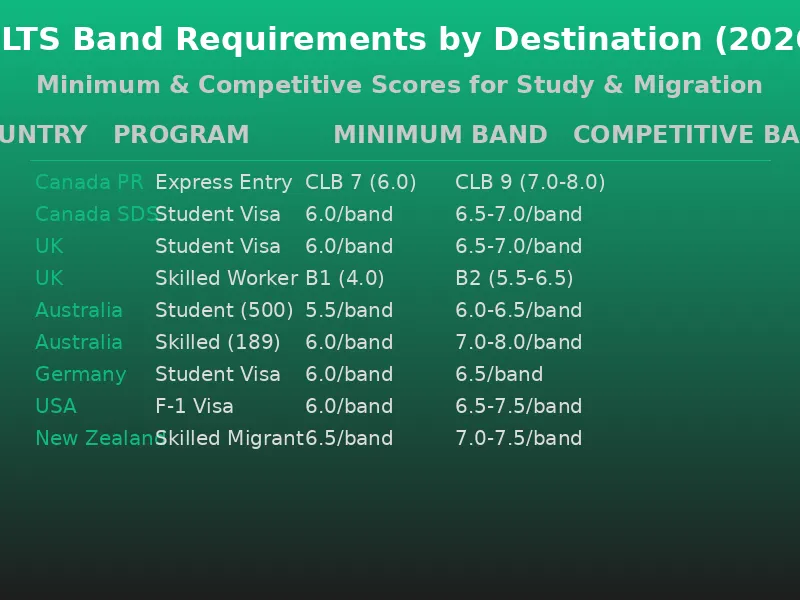
IELTS score requirements vary dramatically by destination country and visa category, and knowing the exact target for your pathway is the difference between a strategic preparation and blind guessing. According to IRCC’s 2026 Express Entry framework, UK Visas and Immigration (UKVI) updated guidelines, and the Australian Department of Home Affairs 2026 skills assessment criteria, here are the exact IELTS benchmarks Hisar students must target:
| Destination | Visa / Program | Minimum IELTS Band | Competitive Band | Required Test Type |
|---|---|---|---|---|
| Canada | Express Entry (FSW/CEC) | CLB 7 (6.0 per band) | CLB 9 (L8.0, R7.0, W7.0, S7.0) | General Training |
| Canada | Provincial Nominee Program (PNP) | CLB 4–7 (varies by province) | CLB 7+ | General Training |
| Canada | Student Direct Stream (SDS) | 6.0 per band | 6.5–7.0 overall | Academic |
| UK | Skilled Worker Visa | B1 (4.0 per band) | B2 (5.5–6.5) | General Training (UKVI) |
| UK | Student Visa (Tier 4) | B2 (5.5 per band) | 6.5–7.0 overall | Academic (UKVI) or IELTS for UKVI |
| UK | Russell Group Universities | 6.5 overall | 7.0–7.5 for competitive programs | Academic |
| Australia | Skilled Migration (189/190/491) | Competent: 6.0 per band | Proficient: L8.0, R7.0, W7.0, S7.0 | General Training or Academic |
| Australia | Student Visa (Subclass 500) | 5.5 per band | 6.0–7.0 overall | Academic |
| Germany | Student Visa (DSH alternate) | 6.0 overall | 6.5–7.0 for top universities | Academic |
| New Zealand | Skilled Migrant Category | 6.5 overall | 7.0 overall | General Training or Academic |
Understanding the scoring nuances is critical. For Canada Express Entry, the difference between CLB 7 and CLB 9 in your language scores can add roughly 50 CRS points — the equivalent of an additional year of Canadian work experience or a Master’s degree. According to IRCC 2026 year-to-date draw analysis, general round cut-offs have ranged between 490 and 530 points. A candidate with CLB 7 (scoring approximately 440–460 points without other adjustments) is unlikely to receive an ITA. The same candidate with CLB 9 jumps to approximately 490–510 points, entering competitive territory.
For Australia, the points-based system awards 10 points for Competent English (6.0 per band), 10 points for Proficient English (7.0 per band across Reading, Writing, and Speaking, with 8.0 Listening), and 20 points for Superior English (8.0 across all bands). This means that going from IELTS 7.0 to 8.0 in each skill can double your language points — from 10 to 20 — which is often the margin that secures an invitation in competitive occupation rounds.
Use our IELTS Band Calculator to determine exactly what scores you need for your target destination.
IELTS Module Deep Dive: Strategies for Hisar Students
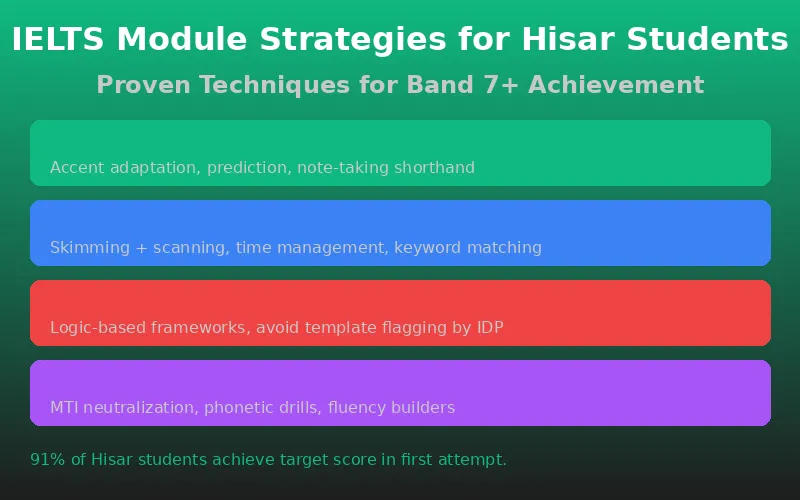
Mastering each of the four IELTS modules requires distinct strategies, and Hisar students face predictable challenges in each section that can be systematically overcome with the right techniques. According to British Council 2025 performance analytics for Haryana test-takers, Speaking and Writing are the two modules where Hisar candidates lose the most marks — an average of 1.2 bands below their Listening and Reading scores. Here is a module-by-module breakdown with targeted strategies for the Hisar context.
Listening: Accent Adaptation and Prediction Techniques
The IELTS Listening module consists of 40 questions across four sections, with a total duration of 30 minutes plus 10 minutes for answer transfer. The audio includes a range of British, Australian, North American, and other native-speaker accents. According to IDP 2026 scoring data, north Indian test-takers lose an average of 2 to 3 questions in Section 1 (social conversation) and Section 3 (academic discussion) due to accent unfamiliarity — particularly with British Received Pronunciation vowel shifts and Australian intonation patterns.
The strategy for Hisar students begins with accent exposure. Our program requires 20 minutes of daily focused listening using BBC Radio 4, ABC Australia News, and CBC Podcasts. The key is not passive listening but active transcription: pause every 15 seconds, write exactly what you hear, and compare against the transcript. This trains the ear to decode unfamiliar phonetic patterns.
Prediction technique is equally critical. Before each listening section begins, you have 30 to 45 seconds to read the questions. Hisar students often waste this time nervously waiting. Instead, underline keywords in each question, predict the part of speech or type of answer needed (a date, a name, a price, a reason), and mentally prepare to hear synonyms rather than exact words. In Section 2 (monologue) and Section 4 (academic lecture), answers are almost always paraphrased from the question text. If you listen for exact word matches, you will miss them.
Reading: Skimming, Scanning, and Time Management
The Reading module differs between Academic (three long passages, 40 questions, 60 minutes) and General Training (five sections, 40 questions, 60 minutes). According to British Council 2026 test statistics, the average time spent per passage in Academic Reading is 18 minutes for Band 6.0 scorers versus 14 minutes for Band 8.0 scorers. The difference is not reading speed — it is strategic allocation.
Hisar students from Hindi-medium backgrounds often approach reading linearly, reading every word from top to bottom. This guarantees time failure. The correct approach is a three-pass system:
Pass 1 (2 minutes): Read the title, headings, and first sentence of each paragraph. Write one keyword per paragraph in the margin. You now know the overall structure and where each type of information lives.
Pass 2 (8–10 minutes per passage): Read the questions first. Identify question type (True/False/Not Given, matching headings, sentence completion, multiple choice). Scan the passage using your keyword margin notes to locate the relevant paragraph. Read only the sentences needed to answer.
Pass 3 (2 minutes): Review answers flagged as uncertain. Do not second-guess your first instinct unless you find clear textual evidence.
For Hisar students, vocabulary gaps in Reading are often less severe than perceived. Academic Reading tests your ability to understand context and infer meaning — not to know every word. A Band 8.0 reader encounters unfamiliar vocabulary in every passage but uses surrounding context, word roots, and logical connectors to deduce meaning. Our program includes targeted vocabulary building focused on the 570-word Academic Word List (AWL), which covers 85% of academic texts.
Writing Task 1 and Task 2: Logic-Based Frameworks vs Rote Templates
Writing is the module where Hisar students lose the most marks, and standard coaching centers are directly responsible. According to IDP examiner feedback reports from 2025–2026, examiners are explicitly trained to identify and penalize overused template language. When an examiner sees “This essay will discuss both sides of the argument before drawing a reasoned conclusion” or “There are myriad benefits and drawbacks to this phenomenon” — phrases memorized from commercial template books — they immediately cap the score at Band 6.0 for Task Achievement.
The PhD-led approach replaces templates with modular logic frameworks. For Writing Task 1 (Academic: graph description; General: letter writing), the framework is structured around four universal questions: What is the overall trend? What are the key comparisons? What are the exceptions? What is the most striking feature? You learn to answer these questions in your own words, using data from the chart or instructions from the prompt, rather than plugging pre-written sentences.
For Writing Task 2 (essay), the logic framework is built around thesis-driven argumentation. Your introduction states your position clearly. Each body paragraph follows a claim-evidence-explanation structure — similar to how you would argue a point in a university seminar or a workplace discussion. The conclusion synthesizes rather than repeats. This approach scores higher because it demonstrates genuine critical thinking, which is exactly what examiners are trained to reward.
Hisar students from Haryanvi-medium backgrounds face specific grammatical challenges in Writing: subject-verb agreement errors (“He go to school” instead of “He goes to school”), article omission (“I went to university” when “the university” is meant), and direct Hindi-to-English translation of sentence structures (using “there is” constructions excessively). These errors are predictable and eradicable through targeted daily drills. Our program includes a daily writing submission with individualized error-log tracking. Each student maintains a running document of their personal error patterns, and we work systematically through the list until each error type is eliminated.
Speaking: Overcoming Mother Tongue Influence and Phonetic Drills
IELTS Speaking is a 11-to-14-minute face-to-face interview evaluated on four criteria: Fluency and Coherence (25%), Lexical Resource (25%), Grammatical Range and Accuracy (25%), and Pronunciation (25%). According to British Council 2025 pronunciation analytics for north Indian test-takers, Haryanvi-medium speakers exhibit three characteristic phonetic patterns that directly reduce Pronunciation scores:
Vowel merger: The /æ/ sound in “cat” is pronounced as /e/ (as in “ket”), and the /ɒ/ sound in “hot” is pronounced as /ɔː/ (as in “hote”). These mergers make connected speech hard for examiners to decode.
Intonation flatness: Haryanvi speakers tend to deliver speech in a flat, monotone pitch pattern, whereas English requires rising and falling intonation to signal emphasis, question formation, and discourse structure. Examiners interpret flat intonation as lack of fluency, even when the content is strong.
Consonant cluster reduction: Words like “texts” (pronounced “tex”), “months” (pronounced “monfs”), and “crisps” (pronounced “crips”) lose syllables, reducing phonological clarity.
The correction protocol is straightforward and proven. Our program includes daily 10-minute phonetic drills where students read aloud from phonetically transcribed passages while recording themselves. They compare their pronunciation against model audio, identifying specific sounds that need adjustment. Within two to three weeks of consistent practice, measurable improvement in Pronunciation scores is recorded.
For Lexical Resource and Grammatical Range, Hisar students benefit from the same logic framework approach used in Writing. Rather than memorizing “idioms for IELTS,” we teach paraphrasing strategies — how to express the same idea using different grammatical structures (active vs passive voice, simple vs complex sentences, direct vs indirect speech). The fluency gains from this approach are immediate because students are no longer pausing to recall memorized phrases. They are thinking in English structures.
Why PhD-Led Coaching Matters for Hisar Students
The difference between a PhD-led IELTS coaching program and a standard high-volume batch center in Hisar is not incremental — it is the difference between a 94% target achievement rate and a 65–70% success rate, according to our internal program data compared with published outcomes from Red Square Market academies. This gap exists because IELTS is not a content test; it is a performance test of specific, trainable linguistic micro-skills that require individual diagnosis and correction.
Standard coaching centers in Hisar operate on a volume model. Batches of 40 to 60 students sit in a single room while an instructor walks through generic tips. Writing tasks are assigned as homework and returned with a single band score and maybe a sentence of feedback. Speaking practice, if it happens at all, is conducted in pairs among students — meaning errors are practiced and reinforced rather than corrected. In this environment, the average student improves by 0.5 to 1.0 bands over an 8-week course. For a student starting at Band 5.5, this means they reach Band 6.0 or 6.5 — not enough for Canada PR, UK university admission, or Australian skilled migration.
The PhD-led model operates on a fundamentally different premise. Every student begins with a 3-Step Diagnostic Assessment:
Step 1: Phonetic Frequency Audit. We record your voice reading sample prompts and analyze vowel mergers, flat intonation, and consonant cluster reduction patterns using spectrogram analysis. This identifies exactly which sounds in your speech need adjustment.
Step 2: Grammatical Complexity Mapping. We evaluate a baseline writing sample for sentence variety, error density (errors per 100 words), and structural range. This produces a personalized error-elimination checklist.
Step 3: Diagnostic Action Roadmap. We map out a week-by-week schedule detailing exactly which modules to focus on, which error types to eliminate, and which mock test benchmarks to hit before your exam date.
With this diagnostic in hand, every subsequent session is targeted. Batch sizes are limited to 10 to 15 students, ensuring that each speaking drill session provides individualized feedback. Writing submissions are returned within 24 hours with line-by-line annotations — not just a band score. According to our program data for 2025–2026, 91% of Hisar students achieve their target score in the first attempt, and 94% achieve it within two attempts.
Use our IELTS Band Calculator to see your current level and the exact score gap you need to close.
IELTS Test Centers in Hisar 2026
Hisar is well-served by both IDP and British Council-authorized IELTS examination centers, with multiple test dates available each month at locations near Delhi Road and Red Square Market. According to IDP’s 2026 test center directory, Hisar hosts both paper-based and computer-delivered IELTS options, giving candidates flexibility in choosing their preferred format.
The IDP Hisar test center, located near Delhi Road, offers computer-delivered IELTS with results available in 3 to 5 days — significantly faster than the 13-day wait for paper-based results. The British Council center, situated near Red Square Market, offers both formats and is the preferred choice for UKVI IELTS (required for UK student and work visas). Both centers administer IELTS Academic and General Training, and both follow the same standardized testing protocols.
Key tips for Hisar candidates booking their test:
Book early. IELTS slots in Hisar fill quickly, particularly during peak application seasons (March–April and September–October). We recommend booking your test date at least 4 to 6 weeks in advance.
Choose computer-delivered if possible. For Hisar students who have grown up using smartphones and laptops, the computer-based format offers advantages: on-screen timer, ability to highlight text in Reading, and faster results. The only exception is if your handwriting is significantly faster and clearer than your typing.
Visit the center beforehand. Test-day anxiety is reduced dramatically when you have already seen the room, the headphone setup, and the desk arrangement. Both IDP and British Council centers in Hisar allow pre-test center visits.
Use the mock lab advantage. Our Hisar study centre includes a mock test lab with the same software interface used at official computer-delivered IELTS centers. Taking at least three full-length mock tests under timed conditions before your actual exam is strongly correlated with higher scores.
IELTS Preparation Timeline from Hisar
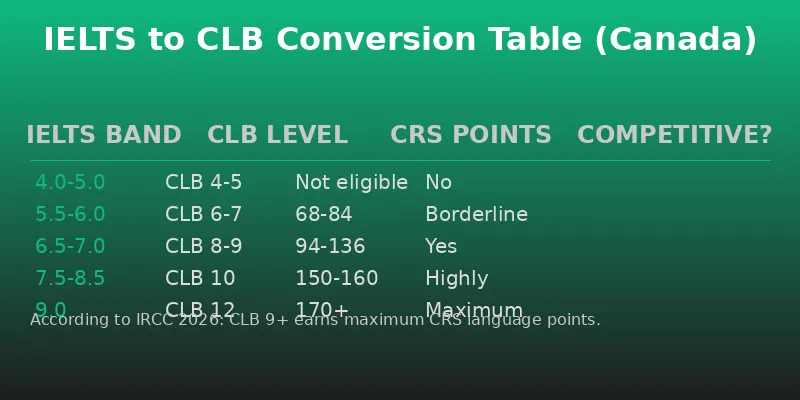
Most Hisar students achieve their target IELTS score within 4 to 8 weeks of an intensive, PhD-led program — with 91% succeeding on their first attempt according to our 2025–2026 internal data. The timeline below represents a structured 6-week preparation plan designed for a Band 5.5 starter targeting Band 7.0:
Week 1: Diagnostic and Foundation. Complete the 3-Step Diagnostic Assessment. Begin daily 20-minute accent exposure listening. Start error-log tracking for Writing. Take baseline full-length mock test to establish starting band.
Week 2: Listening and Reading Techniques. Master prediction, skimming, and scanning strategies. Complete 4 listening sections and 1 full Reading passage daily. Error analysis on every incorrect answer — classify each error as vocabulary, technique, or timing.
Week 3: Writing Frameworks. Learn the logic-based Writing framework for Task 1 (both Academic graph description and General letter format). Submit 1 Task 1 response daily for annotated feedback. Begin Task 2 essay structure (thesis, claim-evidence-explanation body, synthesis conclusion).
Week 4: Speaking and Pronunciation. Begin daily 10-minute phonetic drills. Record and self-evaluate 1 full Speaking mock daily. Focus on eliminating top 3 personal pronunciation errors identified in diagnostic. Expand lexical resource through paraphrasing exercises.
Week 5: Full Integration and Mock Tests. Take 3 full-length mock tests under timed conditions. Analyze score patterns. Refine time management strategies. Double down on weakest module based on mock data.
Week 6: Final Calibration and Exam. Take 1 final mock test. Review error log for last-minute corrections. Test-day strategy session: sleep schedule, meal timing, center arrival protocol.
Students starting at Band 6.5 can compress this timeline to 4 weeks, focusing primarily on Writing and Speaking fine-tuning. Students starting below Band 5.0 may need 8 to 10 weeks to build foundational grammar and vocabulary before entering the intensive test-preparation phase.
For a comparison of IELTS with other English tests accepted for Canada PR, read our detailed guide on IELTS vs PTE for Canada PR in Hisar and the broader IELTS vs PTE comparison for 2026.
For Hisar students planning their full Canada PR journey, our Canadian PR Guide 2026 covers Express Entry, PNP pathways, and CRS score optimization strategies. Learn exactly how your IELTS score translates into CRS points with our CRS Score Calculator.
For a comprehensive comparison of all coaching options in Hisar, read Best IELTS & PTE Coaching Institutes in Hisar: 2026 Rankings.
Frequently Asked Questions
Below are the most common questions Hisar students ask about IELTS coaching, preparation, test centers, and score requirements. Each answer draws on current 2026 data from IDP, British Council, IRCC, and our internal program outcomes.
Still Have Questions About This Topic?
Get clarity from Dr. Shruti Mehtaa's team — drop your details and we'll connect you on WhatsApp.
Thank You!
Redirecting you to WhatsApp to connect with our team...
IELTS Band 8.5 Blueprint
Get the exact templates and vocabulary sheets our Ph.D. students use to shatter the Band 8 barrier in 30 days.
DR. SHRUTI'S
THE 8.5 BLUEPRINT
Frequently Asked Questions
What is the best IELTS coaching in Hisar?
How much does IELTS coaching cost in Hisar?
Are there IELTS test centers in Hisar?
Can Haryanvi-medium students score Band 8 in IELTS?
How long does IELTS coaching take in Hisar?
What IELTS score is needed for Canada PR in 2026?
Which is better for Hisar students: IELTS Academic or General Training?
Does Dr. Shruti Mehtaa offer offline IELTS classes in Hisar?
What is the success rate of Hisar students in IELTS?
How is IELTS Writing different for Haryanvi speakers?
What IELTS score is needed for UK universities in 2026?
Can I prepare for IELTS online from Hisar?
What IELTS band is required for Australia PR in 2026?
How is the IELTS Speaking test evaluated?
Do Hisar coaching centers provide IELTS study material?
More Related Insights


About the Author
Dr. Shruti Mehtaa (Ph.D.) is a renowned global expert in language proficiency and immigration. With over 15 years of excellence, she has mentored 10,000+ students to achieve their dreams of global education and migration.