 +91 92157 48168
MBBS Abroad Guide for Hisar Students: Russia, Bangladesh, Georgia & More in 2026
Dr. Shruti Mehtaa
Director & Ph.D. Expert
Table of Contents
MBBS Abroad for Hisar Students describes the strategic pathway pursued by medical aspirants from Haryana who seek admission to Bachelor of Medicine and Bachelor of Surgery programs at internationally recognized medical universities outside India — primarily in Russia, Bangladesh, Georgia, Kazakhstan, Uzbekistan, the Philippines, and China — to overcome the intense competition for limited seats in Indian government and private medical colleges.
For a student from Hisar — whether studying at a CBSE school near Delhi Road, completing 10+2 at a HBSE board institution in Red Square Market, or preparing for NEET-UG at coaching centres across the city — the dream of becoming a doctor faces a harsh numerical reality. India has approximately 1.4 billion people competing for roughly 100,000 MBBS seats across all government and private medical colleges. With over 2.4 million students appearing for NEET-UG annually, the acceptance rate hovers around 4 to 5 percent. This means 95 out of every 100 qualified medical aspirants in India do not get a seat. Hisar students are not exempt from this arithmetic. The city’s top NEET coaching centres in Red Square Market and near Jindal Chowk produce hundreds of qualified candidates each year, yet only a fraction secure government MBBS seats in Haryana or elsewhere in India. Private medical colleges in India charge tuition fees ranging from ₹15 lakh to ₹1.5 crore per year — placing them financially out of reach for most middle-class families in Hisar. MBBS abroad offers a viable, often more affordable alternative with globally recognized degrees, provided students choose NMC-recognized universities and plan for the FMGE or NExT licensing examination after graduation.
This guide provides a comprehensive, data-driven comparison of every major MBBS destination for Hisar students in 2026. It covers tuition fees, living costs, duration, NMC recognition status, medium of instruction, IELTS requirements, FMGE/NExT pass rates, and practical considerations such as hostel facilities, Indian food availability, and safety for female students. Whether you are a 10+2 science student at a Hisar CBSE school, a NEET repeater at a coaching institute near HAU campus, or a parent evaluating options for your child, this guide gives you the complete picture.
Planning Your MBBS Abroad Journey from Hisar?
Get personalized university shortlisting, NEET guidance, and IELTS preparation from Dr. Shruti Mehtaa's Ph.D. mentoring program in Hisar.
Why Hisar Students Are Choosing MBBS Abroad in 2026
The decision to pursue MBBS abroad is no longer an alternative considered only after failing to secure a seat in India. For a growing number of Hisar medical aspirants, studying abroad is the primary strategy from the outset. According to NMC 2025-2026 data, over 25,000 Indian students currently pursue medical degrees abroad, and this number has grown steadily at 12 to 15 percent annually since 2021. Hisar alone accounts for an estimated 300 to 400 students studying MBBS overseas in any given year — a figure that has more than doubled since 2019.
The NEET competition problem. In 2026, approximately 2.4 million students are expected to appear for NEET-UG, competing for roughly 56,000 government MBBS seats and 44,000 private MBBS seats across India. The top 50 percentile cutoff for general category students has risen to 600+ marks out of 720 in recent years, meaning even students with excellent board scores of 90 percent or above in Physics, Chemistry, and Biology from Hisar CBSE or HBSE schools often fall short. The situation is worse for students from Hindi-medium backgrounds, who face additional challenges in the NEET exam’s biology section due to English terminology gaps.
The cost equation. A private MBBS seat in India costs anywhere from ₹50 lakh to ₹1.5 crore in tuition fees alone, excluding hostel, food, and other expenses over 5.5 years. By contrast, the total cost of an MBBS degree abroad — including tuition, hostel, food, and all incidental expenses — ranges from ₹10 lakh to ₹40 lakh depending on the country and university. For a middle-class family in Hisar, where the average household income from government service, agriculture, or small business ranges from ₹3 lakh to ₹12 lakh per year, the difference between ₹50 lakh and ₹15 lakh is the difference between taking an education loan and paying out of savings or fixed deposits. Many Hisar families also own agricultural land that can be used as collateral for education loans at competitive interest rates through banks near Delhi Road or Red Square Market.
The GJU and HAU advantage. Hisar is home to Guru Jambheshwar University of Science and Technology and Chaudhary Charan Singh Haryana Agricultural University, both of which produce pre-medical and life sciences graduates every year. Students who complete B.Sc in Medical or Biology streams at these universities often apply for MBBS abroad at the graduate-entry level, particularly in countries like the Philippines and China where graduate-entry medical programs are available. The strong foundation in sciences from HAU’s College of Basic Sciences and Humanities or GJU’s Department of Bio-Sciences gives Hisar students an academic edge in first-year MBBS curricula abroad.
Global degree recognition. MBBS degrees from NMC-recognized foreign universities are valid for practice in India after the graduate passes the FMGE or NExT licensing examination. Additionally, graduates from WHO-listed medical universities are eligible to appear for licensing examinations in the United States (USMLE), the United Kingdom (PLAB), Canada (MCCQE), Australia (AMC), and other countries. This global mobility is a significant draw for Hisar students who envision careers beyond India’s borders.
For a broader perspective on why students from this region are looking outward, read our post on top study abroad destinations for Hisar students in 2026.
Top MBBS Destinations for Hisar Students — Complete Comparison
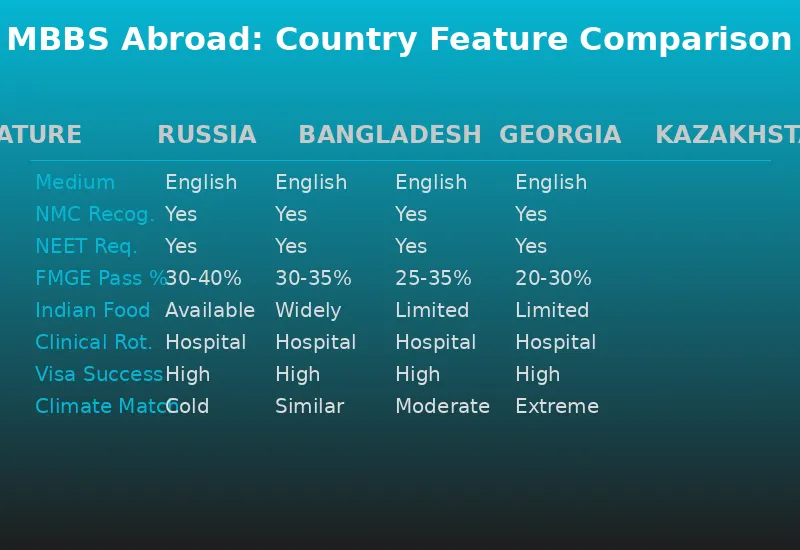
Choosing the right country for MBBS is the single most consequential decision a Hisar medical aspirant will make. The table below provides a side-by-side comparison of the eight most popular MBBS destinations for Indian students, with data updated for the 2026 intake cycle.
| Country | Tuition/Year (USD) | Living Cost/Year (USD) | Duration | NMC Recognition | Medium of Instruction | IELTS Required | FMGE/NExT Pass Rate |
|---|---|---|---|---|---|---|---|
| Russia | $3,000-6,000 | $1,500-2,500 | 6 years | 50+ universities | English | 6.0 | 30-40% |
| Bangladesh | $3,000-5,000 | $1,500-2,500 | 5 years | 25+ universities | English | 6.0-6.5 | 35-45% |
| Georgia | $4,000-8,000 | $2,500-4,000 | 6 years | 10+ universities | English | 6.5 | 25-35% |
| Kazakhstan | $2,500-4,500 | $1,500-2,000 | 5 years | 15+ universities | English | 5.5-6.0 | 20-30% |
| Uzbekistan | $2,000-4,000 | $1,200-1,800 | 5-6 years | 8+ universities | English | 5.5-6.0 | 20-25% |
| Philippines | $3,000-5,000 | $2,000-3,000 | 5-6 years | 12+ universities | English | 6.0 | 15-25% |
| China | $4,000-6,000 | $2,000-3,000 | 5-6 years | 45+ universities | English | 6.0 | 20-30% |
| Caribbean | $8,000-15,000 | $4,000-6,000 | 5-6 years | 5+ universities | English | 6.5-7.0 | 20-30% |
It is critical to note that NMC recognition status changes periodically. As of 2026, Russia has the highest number of NMC-recognized medical universities at over 50, followed by China at 45, Bangladesh at 25, and Kazakhstan at 15. The NMC publishes and updates its list of recognized foreign medical qualifications on its official website at nmc.org.in. Hisar students must verify that their chosen university appears on this list before applying, as degrees from non-recognized universities will not be accepted for practice in India regardless of the student’s FMGE or NExT score.
Russia — MBBS for Hisar Students
Russia has historically been the most popular destination for Indian students pursuing MBBS abroad, and it remains a top choice for Hisar medical aspirants in 2026. With over 50 NMC-recognized medical universities spread across the country, Russia offers the widest selection of approved programs at competitive tuition rates.
NMC-recognized universities in Russia. Some of the most popular Russian medical universities for Indian students include Moscow State University of Medicine and Dentistry, Kazan Federal University, Volgograd State Medical University, Orenburg State Medical University, Bashkir State Medical University, Crimea Federal University, and Far Eastern Federal University. These universities have been on the NMC recognized list for years and have well-established Indian student communities. The recognition status of each university should be verified against the current NMC list before application, as delistings occasionally occur.
Program structure. MBBS in Russia is a 6-year program. The first year covers foundational sciences — Physics, Chemistry, Biology, and Anatomy — taught in English. Years two through five focus on clinical subjects including Pathology, Pharmacology, Microbiology, Surgery, Internal Medicine, Pediatrics, Obstetrics and Gynecology, and Community Medicine. The sixth year is a clinical internship where students rotate through hospital departments under supervision. Most Russian universities also offer optional Russian language courses during the first two years to help students communicate with patients during clinical rotations.
Tuition and living costs. Russian medical universities charge tuition fees ranging from $3,000 to $6,000 per year depending on the university and its location. Universities in Moscow and Saint Petersburg tend toward the higher end of this range, while those in smaller cities like Orenburg, Volgograd, or Kazan offer lower tuition. Living expenses including hostel accommodation, food, transportation, and personal expenses range from $1,500 to $2,500 per year. The 6-year total cost ranges from approximately $25,000 to $45,000 — significantly lower than Indian private medical college fees.
Indian community and lifestyle. Russia hosts one of the largest Indian student communities in the world, with over 15,000 Indian medical students currently enrolled across various universities. This means Indian food is readily available near campus areas, Indian student associations organize cultural events and festivals like Diwali and Holi, and there are established support networks for new arrivals. Hisar students report that the transition to Russia is smoother than expected due to these existing networks. Hostel accommodations are typically university-provided and range from shared rooms to single occupancy options depending on the university and fee structure.
FMGE/NExT pass rates. Students from NMC-recognized Russian universities consistently achieve FMGE pass rates of 30 to 40 percent, which is significantly above the national average of 15 to 25 percent for all foreign medical graduates. Higher-ranked universities like Kazan Federal University and Volgograd State Medical University report even higher pass rates. This is attributed to the rigorous curriculum, English-medium instruction, and the clinical exposure provided during the internship year.
For detailed information on specific Russian universities, see our MBBS in Russia guide.
Bangladesh — Closest and Most Affordable
Bangladesh has emerged as the most popular MBBS destination for Hisar students in recent years, driven by its geographical proximity, cultural familiarity, and the lowest total cost among all major destinations. For a student from Hisar, the journey to Dhaka takes less time by road and air than a trip to Delhi — making Bangladesh feel less foreign than destinations in Europe or Central Asia.
Geographical and cultural proximity. Bangladesh shares a border with West Bengal, and the culture, climate, and cuisine are familiar to Indian students. Hindi-language movies and television are widely available, Bengali is understandable to many north Indians with some exposure, and the climate is similar to Haryana’s summer conditions — hot and humid for much of the year. Indian students in Bangladesh face minimal culture shock compared to those studying in Russia or Georgia, which is a significant factor for parents concerned about their child’s adjustment to a foreign country.
Program structure. MBBS in Bangladesh is a 5-year program followed by a 1-year compulsory internship. The curriculum is closely modeled after the Indian MBBS system, which is not surprising given that Bangladesh’s medical education framework was developed with Indian collaboration. The first two years cover pre-clinical subjects including Anatomy, Physiology, and Biochemistry, while the final three years focus on clinical subjects. Instruction is in English, though Bengali is used during patient interactions in clinical settings.
NMC-recognized universities. Bangladesh has over 25 NMC-recognized medical colleges. The most well-known include Dhaka Medical College, Sir Salimullah Medical College, Mymensingh Medical College, Rajshahi Medical College, Chittagong Medical College, and private institutions like Bangladesh Medical College, Ibrahim Medical College, and Enam Medical College. Hisar students should verify that their chosen college appears on the NMC recognized list, as a small number of Bangladesh medical colleges have been delisted in recent years.
Tuition and living costs. Bangladesh offers tuition fees of $3,000 to $5,000 per year, with a total 5-year program cost of $15,000 to $25,000. Living expenses including hostel and food range from $1,500 to $2,500 per year. For the complete 5-year program plus internship, total expenses including tuition, accommodation, food, travel, and miscellaneous costs range from $18,000 to $30,000. This makes Bangladesh the most affordable MBBS destination for Hisar students after Uzbekistan and Kazakhstan. Many Hisar families find Bangladesh’s total cost comparable to or lower than the donation and tuition fees demanded by private medical colleges in Haryana, Rajasthan, or Uttar Pradesh.
FMGE/NExT pass rates. Bangladesh produces the highest FMGE pass rates among all MBBS abroad destinations, with students from top Bangladeshi medical colleges achieving pass rates of 35 to 45 percent. The curriculum’s alignment with the Indian system, the use of English as the medium of instruction, and the rigorous clinical training contribute to this performance. For Hisar students, the familiarity of the examination pattern and the availability of Indian textbooks and reference materials further enhance their preparation for FMGE or NExT.
For detailed information on specific Bangladesh medical colleges, see our MBBS in Bangladesh guide.
Georgia — European Standards
Georgia has gained significant traction among Indian medical aspirants over the past five years, and it now ranks among the top three MBBS destinations for Hisar students. The country offers a European medical education at a fraction of the cost of Western European or North American programs, with the added advantage of WHO and ECFMG recognition that opens doors to practice in multiple countries.
European accreditation and global recognition. Georgian medical universities are accredited by the European standards body and listed in the World Directory of Medical Schools. The Medical Council of India (now NMC) has recognized over 10 Georgian universities. Georgian medical degrees are also recognized by the Educational Commission for Foreign Medical Graduates (ECFMG), making Georgia a viable pathway for students who aspire to take the USMLE and practice in the United States. This is a significant differentiator from Bangladesh and Central Asian destinations, where USMLE preparation infrastructure is less developed.
Top Georgian universities for Indian students. The most popular Georgian medical universities include Tbilisi State Medical University (TSMU), Ivane Javakhishvili Tbilisi State University, Akaki Tsereteli State University, David Tvildiani Medical University, and Caucasus International University. TSMU is the most established and widely recognized, with a curriculum that meets both European and international standards.
Program structure and duration. MBBS in Georgia is a 6-year program delivered entirely in English. The curriculum follows the European Credit Transfer and Accumulation System (ECTS), which facilitates credit transfer and recognition across European universities. Years one and two focus on basic medical sciences, years three through five cover clinical subjects, and the sixth year is dedicated to clinical clerkship rotations in affiliated hospitals. Graduates receive an MD (Doctor of Medicine) degree equivalent to the MBBS qualification.
Tuition and living costs. Georgian medical universities charge tuition fees of $4,000 to $8,000 per year. TSMU, being the premier institution, charges at the higher end of this range. Living costs in Georgia are higher than in Bangladesh or Central Asia but lower than in Western Europe. Monthly expenses including hostel accommodation, food, transportation, and personal items range from $250 to $400. The total 6-year cost including tuition and living expenses ranges from $25,000 to $50,000.
USMLE pathway. Georgia’s ECFMG recognition means that graduates are eligible to apply for the USMLE Step 1 and Step 2 CK examinations. Several Georgian universities have dedicated USMLE preparation programs, and graduates have reported competitive pass rates. For Hisar students who may aspire to practice in the United States or Canada after completing their MBBS, Georgia offers the most accessible pathway among all affordable MBBS destinations.
For detailed information on specific Georgian universities, see our MBBS in Georgia guide.
Kazakhstan and Uzbekistan — Budget Options
For Hisar families with limited budgets, Kazakhstan and Uzbekistan offer the most affordable NMC-recognized MBBS programs globally. These Central Asian countries have invested significantly in medical education over the past decade, and their universities now attract a growing number of Indian students seeking quality education at minimal cost.
Kazakhstan — the growing favorite. Kazakhstan has over 15 NMC-recognized medical universities, including Al-Farabi Kazakh National University, Kazakh National Medical University named after S.D. Asfendiyarov, Astana Medical University, Karaganda State Medical University, and South Kazakhstan Medical Academy. Tuition fees range from $2,500 to $4,500 per year, with living expenses of $1,500 to $2,000 per year. The 5-year program totals $15,000 to $25,000 — one of the lowest cost options available. Instruction is in English, and universities provide foundation courses in Russian and Kazakh for clinical communication.
Uzbekistan — the lowest cost option. Uzbekistan has 8 NMC-recognized medical universities with tuition fees of $2,000 to $4,000 per year and living expenses of $1,200 to $1,800 per year. The total 5-6 year cost ranges from $12,000 to $22,000 — the lowest among all NMC-recognized options. Key universities include Tashkent Medical Academy, Samarkand State Medical Institute, Bukhara State Medical Institute, and Andijan State Medical Institute. The NMC has recognized these institutions, and Indian students form a growing community in Tashkent and Samarkand.
Student life for Indian students. Both Kazakhstan and Uzbekistan have well-established Indian student communities with dedicated hostel facilities, Indian mess facilities, and cultural support systems. The climates are continental with cold winters and warm summers — colder than Hisar but manageable with proper preparation. Halal food is readily available, and Hindu students can find vegetarian options in most university-hosted facilities. The lifestyle is conservative and safe, which is reassuring for parents of female students.
FMGE/NExT considerations. FMGE pass rates for graduates of Kazakh and Uzbek universities range from 20 to 30 percent, which is close to the national average. Students from the stronger universities in Almaty and Tashkent tend to perform better. The key to success is selecting a university with a strong preclinical foundation program and supplementing the curriculum with Indian-standard FMGE preparation materials during the final years of study.
NEET and NExT Requirements for Hisar Medical Aspirants
Understanding the regulatory landscape is essential for any Hisar student planning MBBS abroad. The National Medical Commission has established clear guidelines that govern foreign medical education for Indian students, and these guidelines have evolved significantly with the introduction of NExT.
NEET-UG is mandatory. NMC regulations require all Indian students seeking MBBS abroad to qualify NEET-UG. This requirement applies regardless of the country or university. Hisar students must obtain a valid NEET score with the minimum percentile prescribed for their category — 50th percentile for general category, 40th percentile for OBC/SC/ST, and 45th percentile for general-PwBD. A valid NEET score is required not just for admission but also to appear for the FMGE or NExT examination after graduation. Students who leave India without clearing NEET will find themselves unable to practice in India regardless of their foreign degree.
The transition from FMGE to NExT. As of 2025, the National Exit Test (NExT) has replaced the Foreign Medical Graduate Examination (FMGE) as the licensing examination for Indian citizens holding foreign medical degrees. NExT serves a dual purpose: it acts as the licensing exam for foreign medical graduates (replacing FMGE) and as the National Eligibility-cum-Entrance Test for postgraduate medical education (replacing NEET-PG). According to NMC 2026 guidelines, NExT Step 1 will be the qualifying examination for foreign medical graduates seeking registration in India, while NExT Step 2 will serve as the PG entrance examination.
Preparation strategy for Hisar students. Hisar students planning MBBS abroad should begin their NEET-UG preparation alongside their 10+2 studies at CBSE or HBSE schools in Hisar. Coaching centres near Red Square Market and Jindal Chowk offer NEET preparation programs, and many students combine their board exam preparation with NEET coaching. The NEET score remains valid for three years, so students can take the exam during their 12th standard and use the score to apply for MBBS abroad programs in the same or subsequent years.
Minimum eligibility requirements by country. Each country has specific eligibility criteria that Hisar students must meet:
- Russia: 10+2 with minimum 50% in PCB (40% for reserved), NEET-UG qualified, IELTS 6.0 minimum.
- Bangladesh: 10+2 with minimum 60% in PCB (varies by college), NEET-UG qualified, IELTS 6.0-6.5.
- Georgia: 10+2 with minimum 50% in PCB, NEET-UG qualified, IELTS 6.5.
- Kazakhstan: 10+2 with minimum 50% in PCB, NEET-UG qualified, IELTS 5.5-6.0.
- Uzbekistan: 10+2 with minimum 50% in PCB, NEET-UG qualified, IELTS 5.5-6.0.
Students should note that some universities may accept MOI (Medium of Instruction) certificates in lieu of IELTS, but this varies by institution and should be verified before application.
IELTS and PTE Requirements for MBBS Abroad
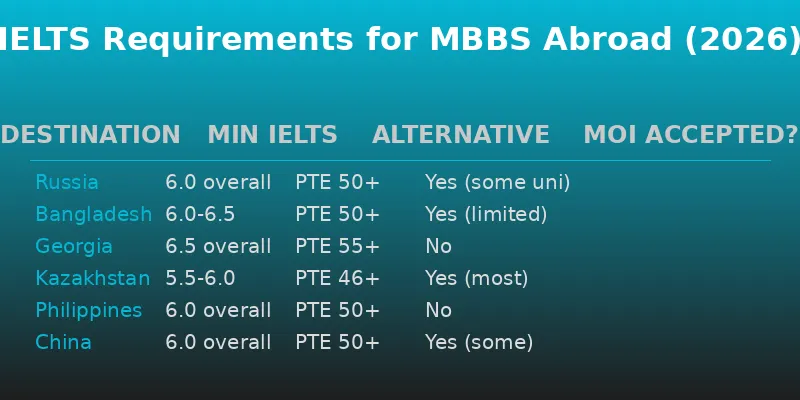
English proficiency testing is a critical component of the MBBS abroad application process. Most universities require proof of English proficiency through standardized tests, and Hisar students from Hindi or Haryanvi-medium backgrounds must prepare strategically to meet the required thresholds.
Country-wise IELTS requirements for MBBS programs:
| Destination | Minimum IELTS Overall | Minimum Band Requirement | Alternative Accepted |
|---|---|---|---|
| Russia | 6.0 | 5.5 each | PTE 50+, MOI accepted at some universities |
| Bangladesh | 6.0-6.5 | 5.5-6.0 each | PTE 50-58, MOI accepted at some colleges |
| Georgia | 6.5 | 6.0 each | PTE 58+, TOEFL iBT 80+ |
| Kazakhstan | 5.5-6.0 | 5.0-5.5 each | PTE 45-50, MOI accepted |
| Uzbekistan | 5.5-6.0 | 5.0-5.5 each | PTE 45-50, MOI accepted |
| Philippines | 6.0 | 5.5 each | PTE 50+, TOEFL iBT 70+ |
| China | 6.0 | 5.5 each | PTE 50+, MOI accepted at some universities |
| Caribbean | 6.5-7.0 | 6.0-6.5 each | PTE 58-65, TOEFL iBT 85+ |
Why Hisar pre-medical students need targeted IELTS preparation. Hisar students preparing for MBBS abroad face a dual challenge: they must balance their NEET-UG preparation with IELTS preparation, and they must overcome the specific English proficiency barriers common to Hindi and Haryanvi-medium students. According to IDP 2026 data on north Indian test-takers, students from Haryana’s non-metro districts score an average of 1.0 to 1.5 bands lower in IELTS Speaking and Writing compared to their metro counterparts in Delhi and Mumbai. This gap is entirely attributable to mother tongue influence and lack of English exposure — not lack of intelligence or ability.
Dr. Shruti Mehtaa’s IELTS coaching program in Hisar specifically prepares pre-medical students for the English proficiency requirements of MBBS abroad programs. The program includes:
- Medical vocabulary building: Focus on Latin and Greek roots commonly used in medical terminology, enabling students to decode unfamiliar medical terms encountered in first-year Anatomy, Physiology, and Biochemistry lectures abroad.
- Accent neutralization: Hisar students often struggle with British and North American accents in IELTS Listening. The program includes daily accent exposure exercises using medical lectures and clinical case discussions.
- Academic Writing for medical context: Writing Task 2 topics in IELTS Academic often relate to healthcare, ethics, and science. Hisar students learn to structure arguments on medical topics using logic-based frameworks rather than rote templates.
- Speaking for clinical communication: The IELTS Speaking module’s Part 2 and Part 3 require candidates to discuss abstract ideas and personal experiences. Our program prepares students to speak fluently on health-related topics, which serves double duty for future clinical communication.
For complete details on our IELTS preparation program for Hisar pre-medical students, see our IELTS coaching in Hisar page.
Cost Comparison for Hisar Families
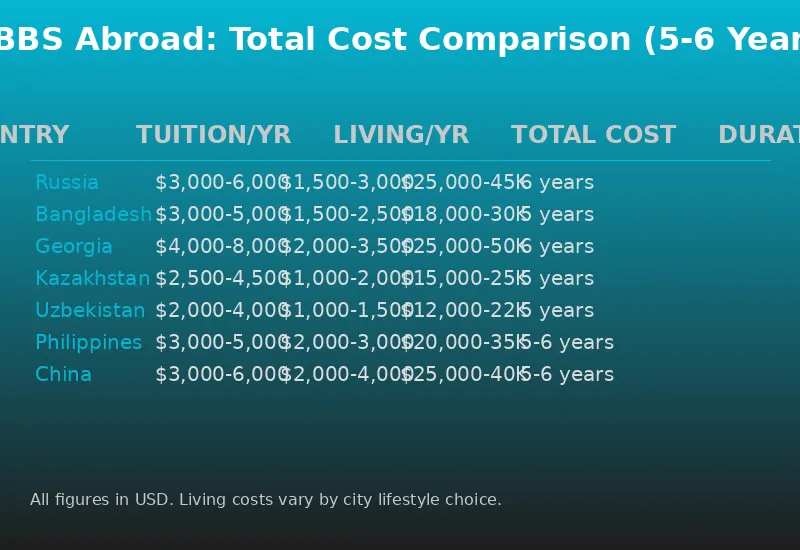
The financial investment required for MBBS abroad is a central concern for Hisar families. The table below provides a comprehensive cost comparison across all major destinations, covering tuition fees, living expenses, and total program cost.
| Country | Tuition/Year (USD) | Living/Year (USD) | Program Duration | Total Tuition (USD) | Total Program Cost (USD) |
|---|---|---|---|---|---|
| Russia | $3,000-6,000 | $1,500-2,500 | 6 years | $18,000-36,000 | $25,000-45,000 |
| Bangladesh | $3,000-5,000 | $1,500-2,500 | 5 years | $15,000-25,000 | $18,000-30,000 |
| Georgia | $4,000-8,000 | $2,500-4,000 | 6 years | $24,000-48,000 | $25,000-50,000 |
| Kazakhstan | $2,500-4,500 | $1,500-2,000 | 5 years | $12,500-22,500 | $15,000-25,000 |
| Uzbekistan | $2,000-4,000 | $1,200-1,800 | 5-6 years | $10,000-24,000 | $12,000-22,000 |
| Philippines | $3,000-5,000 | $2,000-3,000 | 5-6 years | $15,000-30,000 | $20,000-35,000 |
| China | $4,000-6,000 | $2,000-3,000 | 5-6 years | $20,000-36,000 | $25,000-40,000 |
| Caribbean | $8,000-15,000 | $4,000-6,000 | 5-6 years | $40,000-90,000 | $50,000-100,000 |
EMI and loan options for Hisar families. Most nationalized banks operating in Hisar — including State Bank of India, Punjab National Bank, Bank of Baroda, and Haryana Gramin Bank — offer education loans for MBBS abroad programs. Loan amounts typically cover tuition fees, living expenses, and travel costs, with repayment beginning 6 to 12 months after course completion. Banks near Delhi Road and Red Square Market in Hisar have dedicated education loan officers who process applications for foreign medical programs. Loan amounts of up to ₹40 lakh are available without collateral for programs at recognized universities, and amounts exceeding this require property or fixed deposit collateral.
Hidden costs to consider. Hisar families should budget for the following additional expenses beyond tuition and living costs:
- Application fees: $50-200 per university application.
- IELTS/PTE exam fees: ₹16,000 for IELTS, ₹15,000 for PTE Academic.
- Visa application fees: $160-500 depending on the destination country.
- Airfare: ₹30,000-80,000 for round-trip or one-way tickets depending on destination.
- Health insurance: $200-500 per year depending on the country.
- NMC registration fee: ₹1,00,000 approximately for FMGE or NExT examination and registration.
- Travel for FMGE/NExT: Return travel to India for the examination.
- Incidental expenses: Books, medical equipment, lab coats, and personal items ($300-800 per year).
FMGE and NExT Preparation Strategy
Success in the FMGE or NExT licensing examination is the ultimate determinant of whether an MBBS degree from abroad translates into a medical career in India. Hisar students must approach this examination with a strategic mindset from the first year of their program.
Start preparing in the fourth year. The FMGE/NExT syllabus covers all subjects taught across five years of the MBBS curriculum. Waiting until after graduation to begin preparation is a recipe for failure. Successful candidates begin FMGE/NExT preparation in their fourth year of MBBS, using Indian-standard textbooks and question banks alongside their university curriculum. The recommended resources include:
- Pre-PG prep platforms: Marrow, PrepLadder, and Medicoapps offer FMGE-specific courses with video lectures, question banks, and mock tests. These platforms are accessible online from anywhere in the world, including from hostels in Russia, Bangladesh, or Georgia.
- Indian standard textbooks: Students should carry standard Indian textbooks such as Davidson’s Principles of Internal Medicine (Indian edition), Bailey and Love’s Short Practice of Surgery, Shaw’s Textbook of Gynecology, and Piyush Gupta’s Pediatrics to their study abroad destination.
- Previous year question banks: Solving the last 10 years of FMGE/NExT question papers is essential. Pattern recognition and question repetition are well-documented phenomena in Indian medical licensing exams.
Study plan for foreign medical graduates. A structured study plan for Hisar students studying MBBS abroad should include:
- Years 1-2: Focus on building a strong foundation in Anatomy, Physiology, and Biochemistry. Use Indian textbooks alongside university materials. Create Anki flashcards for long-term retention.
- Year 3: Begin Pathology, Pharmacology, Microbiology, and Forensic Medicine. Start watching FMGE preparation videos on foundational subjects. Begin solving subject-wise question banks.
- Year 4: Start FMGE-specific preparation in earnest. Complete at least two subjects per month. Take subscription to an online prep platform. Begin attempting subject-specific mock tests.
- Year 5: Complete syllabus coverage. Take full-length mock tests every two weeks. Identify weak areas and allocate additional time accordingly.
- Year 6 (Internship): Maximize clinical exposure while maintaining daily preparation time. Take full-length FMGE mock tests weekly. Focus on clinical subjects — Medicine, Surgery, Pediatrics, OB-GYN.
FMGE/NExT pass rate optimization. The overall FMGE pass rate for foreign medical graduates has historically been 15 to 25 percent. However, Hisar students who follow a structured preparation strategy and study at NMC-recognized universities with strong curricula can achieve pass rates in the 30 to 45 percent range. The key factors that correlate with higher pass rates include:
- Studying at an NMC-recognized university.
- English-medium instruction throughout the program.
- Regular clinical exposure during internship.
- Early and consistent use of Indian FMGE preparation materials.
- Taking dedicated FMGE coaching during or after the MBBS program.
Frequently Asked Questions
Below are the most common questions Hisar students and their families ask about pursuing MBBS abroad in 2026. Each answer draws on current NMC guidelines, university admissions data, and practical experience from Hisar students currently studying abroad.
Which country is best for MBBS abroad for Hisar students in 2026?
Russia, Bangladesh, and Georgia are the top three MBBS destinations for Hisar students. Russia offers globally recognized degrees from NMC-approved universities with annual fees of $3,000-6,000. Bangladesh provides affordable tuition ($3,000-5,000/year) with cultural familiarity. Georgia offers European-accredited programs in English with fees of $4,000-8,000/year. The best choice depends on your budget, career goals, and personal preferences.
What is the total cost of MBBS abroad from Hisar?
Total 5-6 year MBBS costs including tuition and living expenses vary by country: Russia ($25,000-45,000), Bangladesh ($18,000-30,000), Georgia ($25,000-50,000), Kazakhstan ($15,000-25,000), Uzbekistan ($12,000-22,000), Philippines ($20,000-35,000), and China ($25,000-40,000). Hisar families can plan based on budget with EMI options available through nationalized banks.
Is NEET required for MBBS abroad 2026?
Yes, NEET-UG is mandatory for Indian students seeking MBBS abroad according to NMC 2026 guidelines. A valid NEET score is required for eligibility to appear for FMGE/NExT after graduation. Hisar students from HAU, GJU, or coaching centers in Red Square Market must qualify NEET with the minimum required percentile.
What IELTS score is needed for MBBS abroad?
IELTS requirements vary by country: Russia (IELTS 6.0 minimum), Bangladesh (IELTS 6.0-6.5), Georgia (IELTS 6.5), Kazakhstan (IELTS 5.5-6.0), Philippines (IELTS 6.0), and Caribbean (IELTS 6.5-7.0). PTE Academic is also accepted by most universities as an alternative.
Is MBBS from Russia valid in India?
Yes, MBBS degrees from NMC-recognized Russian universities are valid in India provided the graduate passes the FMGE or the new NExT (National Exit Test) which replaced FMGE from 2025. As of 2026, NExT serves as both the licensing exam and PG entrance.
How much does MBBS in Bangladesh cost for Hisar students?
MBBS in Bangladesh costs $3,000-5,000 per year in tuition plus $1,500-2,500 per year in living expenses. Total 5-year program cost: $18,000-30,000. Bangladesh is the most popular choice for Hisar students due to proximity, Hindi/Bengali cultural familiarity, and similar climate conditions.
What is the FMGE/NExT pass percentage for Hisar students studying abroad?
According to NMC 2026 data, the overall FMGE pass percentage for Indian students who studied MBBS abroad is 15-25%. However, students from NMC-recognized universities in Russia and Bangladesh consistently achieve higher pass rates (30-40%). Choosing the right university is critical for Hisar medical aspirants.
Can I study MBBS abroad without IELTS?
Some universities in Russia and Bangladesh accept students without IELTS if they provide a Medium of Instruction (MOI) certificate from their previous institution. However, having IELTS 6.0+ significantly broadens university options and strengthens visa applications. Dr. Shruti’s IELTS program in Hisar specifically prepares pre-medical students.
Which MBBS abroad destination has the lowest fees?
Uzbekistan offers the lowest MBBS fees at $2,000-4,000 per year (total $12,000-22,000 for 5-6 years), followed by Kazakhstan ($2,500-4,500/year, total $15,000-25,000), and Bangladesh ($3,000-5,000/year, total $18,000-30,000). These destinations offer NMC-recognized degrees at significantly lower costs than Indian private medical colleges.
What is the eligibility for MBBS abroad for Hisar students?
Basic eligibility includes: minimum 50% in Physics, Chemistry, and Biology in 10+2 (40% for reserved categories), NEET-UG qualification, minimum age 17 years, and valid English proficiency test score (IELTS 5.5-6.5 depending on destination). Hisar students from CBSE or HBSE boards are eligible for all major MBBS destinations.
How long is MBBS in Russia?
MBBS in Russia is typically 6 years, including 1 year of foundation sciences plus 5 years of clinical training. Russian medical degrees are recognized by NMC, WHO, and ECFMG. Many universities offer English-medium instruction with optional Russian language courses for clinical rotations.
Is MBBS from Georgia recognized in India?
Yes, MBBS degrees from NMC-recognized Georgian universities such as Tbilisi State Medical University and Ivane Javakhishvili Tbilisi State University are valid in India after passing FMGE/NExT. Georgian degrees are also recognized by WHO and ECFMG, allowing graduates to practice in India, the US, Europe, and other countries.
What is the MBBS in Philippines duration and cost?
MBBS in Philippines (MD program) is 5-6 years with tuition fees of $3,000-5,000 per year. The curriculum follows the US education system with heavy focus on clinical rotations. Total cost including living expenses: $20,000-35,000. Philippine medical graduates have high USMLE pass rates due to the American-style curriculum.
Can Hisar girls study MBBS abroad safely?
Yes, all major MBBS destinations host large Indian student communities with dedicated hostels and safety provisions. Russia, Georgia, and Bangladesh have established Indian student associations that provide support. Hisar families can visit campuses through university-organized familiarization tours before enrollment.
How do I choose the right MBBS university abroad?
Key selection criteria: NMC recognition status, university ranking and accreditation, medium of instruction, clinical rotation quality, FMGE/NExT pass percentage of alumni, hostel facilities, Indian food availability, and total cost. Dr. Shruti Mehtaa’s study abroad guidance helps Hisar students evaluate these factors systematically.
For additional guidance on writing your Statement of Purpose for medical university applications, see our SOP writing guide and our detailed article on how to write a winning SOP for medical school abroad.
Choosing to pursue MBBS abroad is one of the most consequential decisions a Hisar medical aspirant can make. With proper planning, the right university selection, and targeted preparation for NEET, IELTS, and eventually FMGE or NExT, Hisar students can build successful medical careers that would have been inaccessible through the intensely competitive Indian medical education system. The key is to approach the journey systematically — from 10+2 preparation through NEET, from IELTS preparation at a program designed for Hisar students, through university selection, and finally through the licensing examination that opens the door to medical practice in India.
The landscape of medical education in 2026 offers Hisar students more options and more pathways than ever before. Whether you choose Russia for its established Indian community and NMC recognition, Bangladesh for its affordability and proximity, Georgia for its European accreditation and USMLE pathway, or Kazakhstan and Uzbekistan for their budget-friendly NMC-recognized programs, the infrastructure and support systems exist to help you succeed. The students who thrive are those who research thoroughly, prepare strategically, and commit to the long-term process of becoming a doctor.
For personalized guidance on MBBS abroad pathways for Hisar students — including university shortlisting, NEET preparation strategy, IELTS coaching, and application support — visit Dr. Shruti Mehtaa’s practice at our Dabra Chowk centre or reach out through our website. We provide end-to-end support tailored specifically for medical aspirants from Hisar targeting global medical education in 2026.
Still Have Questions About This Topic?
Get clarity from Dr. Shruti Mehtaa's team — drop your details and we'll connect you on WhatsApp.
Thank You!
Redirecting you to WhatsApp to connect with our team...
Global Study Abroad Handbook
Our comprehensive guide to university admissions, SOP writing, and visa processes for top global destinations.
DR. SHRUTI'S
THE 8.5 BLUEPRINT
Frequently Asked Questions
Which country is best for MBBS abroad for Hisar students in 2026?
What is the total cost of MBBS abroad from Hisar?
Is NEET required for MBBS abroad 2026?
What IELTS score is needed for MBBS abroad?
Is MBBS from Russia valid in India?
How much does MBBS in Bangladesh cost for Hisar students?
What is the FMGE/NExT pass percentage for Hisar students studying abroad?
Can I study MBBS abroad without IELTS?
Which MBBS abroad destination has the lowest fees?
What is the eligibility for MBBS abroad for Hisar students?
How long is MBBS in Russia?
Is MBBS from Georgia recognized in India?
What is the MBBS in Philippines duration and cost?
Can Hisar girls study MBBS abroad safely?
How do I choose the right MBBS university abroad?
More Related Insights


About the Author
Dr. Shruti Mehtaa (Ph.D.) is a renowned global expert in language proficiency and immigration. With over 15 years of excellence, she has mentored 10,000+ students to achieve their dreams of global education and migration.